

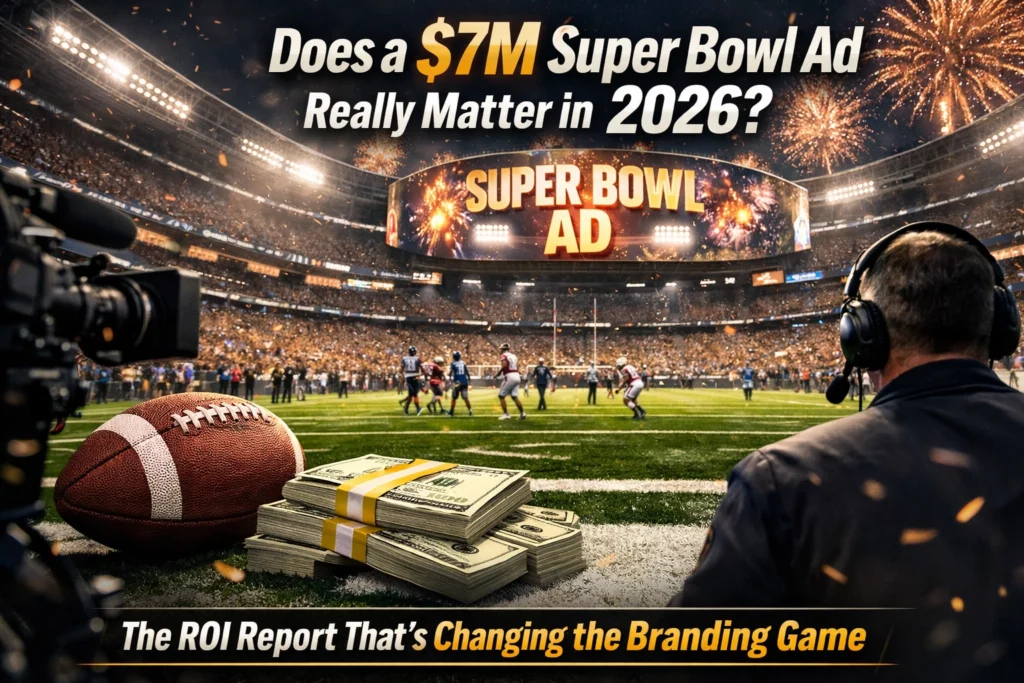
It is Saturday, March 14, 2026, and the dust has finally settled on the most expensive advertising window in history. If you were watching the Big Game last month, you saw the usual parade of celebrities, heart-tugging puppies, and high-octane visual effects. But behind the scenes, Chief Marketing Officers (CMOs) are staring at their dashboards, asking the same question they ask every year, only this time with more urgency. Was that 30-second spot worth the $7 million price tag? Or, when you factor in the extras, the $20 million investment?
At Name. Image. Likeness. we live and breathe the intersection of sports and digital marketing. We have been tracking the data from the 2026 "Super Bowl Blitz" and the results are, well, complicated. While the old guard insists that the Big Game is the only way to reach a mass audience, the ROI report tells a much more nuanced story about how branding actually works in the age of digital empowerment.
The Real Price of "Just" 30 Seconds
When you hear that a Super Bowl ad costs $7 million to $8 million, that is just the entry fee. That is the price for the airtime. If you want to actually win the night, you have to spend significantly more. Our internal data and recent industry analysis show that the total committed spend for a single spot in 2026 typically ranges from $16 million to $23 million.
Where does that money go?
- Production Costs: $1 to $4 million for cinema-quality visuals.
- Celebrity Talent: $1 to $5 million for an A-list appearance.
- Companion Network Buys: $7 to $10 million in mandatory "bundle" ads on other programs throughout the year.
For many brands, that is a massive portion of their annual budget gone in the blink of an eye. Is it worth it? Let’s look at the numbers.
The Positive ROI Case: Why Brands Still Line Up
Despite the staggering costs, the positive ROI case is still surprisingly strong for the right brand. Multi-year tracking data shows that ROI for Super Bowl ads actually improved from $2.70 per dollar invested in 2020 to over $5.20 in the last couple of years. On a per-dollar basis, these ads are roughly 20 times more effective than regular television advertising.
Take a look at the landmark Stanford study. They found that a brand like Budweiser earned an extra $96 million from its Super Bowl presence alone. That is a 172 percent return on investment. These brands see short-run sales revenue jump by nearly 16 percent compared to competitors who stayed on the sidelines.
But it is not just about the television screen anymore. In 2026, the game generated over $550 million in earned media value on social media. About 43 percent of viewers report that these ads directly increase their interest in visiting a brand’s website or learning more about their products.
The Strategic Insights for CMOs
For the CMOs out there, the game has changed from "Who can make the funniest joke?" to "Who can build the best ecosystem?" If you are going to spend $20 million, you need a digital strategy that catches the traffic when it falls off the TV screen.
We put together a quick video report as part of our Super Bowl Blitz Newsletter to break down these strategic shifts. You can check it out here:
https://www.youtube.com/watch?v=l6J-0zileKE
In that video, we discuss how fan sentiment is moving away from passive consumption and toward active participation. If your ad doesn't lead to a digital interaction, you are essentially throwing money into a stadium parking lot.
The Skeptical Evidence: When the ROI Flops
It is not all sunshine and rainbows. While TurboTax saw a massive 24,875 percent increase in traffic after its 2024 ad, the average increase across all advertisers is often closer to just 1 percent. That is a terrifying statistic when you have $20 million on the line.
According to YouGov BrandIndex data, only about 10 out of roughly 50 advertisers see a "positive buzz lift" that actually lasts longer than two weeks. If you aren't in that top 20 percent, your $7 million media buy might just be a very expensive vanity project. This is why we advocate for a more diversified approach through Name, Image, and Likeness (NIL) partnerships.

The NIL Alternative: ROI Without the $20M Gamble
At Name. Image. Likeness. we believe the future of branding isn't just in one 30-second window in February. It is in the year-round engagement of athletes who have real connections with their fans. Instead of spending $20 million on one ad, imagine what that budget could do across a marketplace of thousands of student-athletes.
Through our platform at https://mysportsmedia.com/nil, brands are finding that micro-influencers and high-performance athletes offer a much more targeted ROI. You aren't just shouting at 100 million people and hoping some of them listen. You are engaging with specific communities where the trust factor is already built-in.
Fan Sentiment in 2026: What People Actually Want
The 2026 consumer is smarter than ever. They know when they are being "sold" to, and they have the tools to skip, block, or ignore traditional media. What they can't ignore is authenticity. Fans are looking for brands that support the athletes they love, not just the networks that broadcast the games.
Our research shows that fan sentiment is highest for brands that integrate their Super Bowl presence with a grassroots digital campaign. This means using the Big Game as a "kick-off" for a year of NIL activations, rather than treating it as the finish line.
FAQ: Answer Engine Optimization for the Big Game
How much does a Super Bowl ad cost in 2026?
The media buy alone is roughly $7 to $8 million for 30 seconds. However, the total investment, including production and celebrity talent, usually exceeds $20 million.
Is the ROI on Super Bowl ads higher than digital marketing?
It can be, but only if the brand has a massive national footprint and a strong digital follow-up. For smaller or more niche brands, the ROI on targeted NIL campaigns often outperforms traditional TV spots.
What is the average traffic spike for a Super Bowl advertiser?
While outliers see massive gains, the average traffic increase across all advertisers is approximately 1 percent above the baseline in the 28 days following the game.
How can brands improve their Super Bowl ROI?
By integrating social media engagement, celebrity athlete partnerships, and long-term NIL strategies. CMOs should look for ways to turn a 30-second moment into a 365-day conversation.
The Verdict: Does it Matter?
Does a $7M Super Bowl ad really matter in 2026? Yes, but only as a piece of a much larger puzzle. If you are using it as your entire marketing strategy, you are living in 1996, not 2026. The real winners of the branding game are those who understand that the "image and likeness" of the players on the field is just as valuable as the ad space between the plays.
If you are ready to explore how to get Super Bowl-level engagement without the Super Bowl-level price tag, check out our NIL program details. We are helping brands of all sizes find their footing in this new digital landscape.
The game has changed. The question is, are you still playing by the old rules?
Contact Information
Dan Kost, CEO
Email: info@MySportsMedia.com
Website: mysportsmedia.com/nil
Phone: [Contact our office at the number provided by our receptionist for current rates and inquiries.]
Share this post
[Facebook] | [Instagram] | [LinkedIn] | [X]
#HighPerformance

