

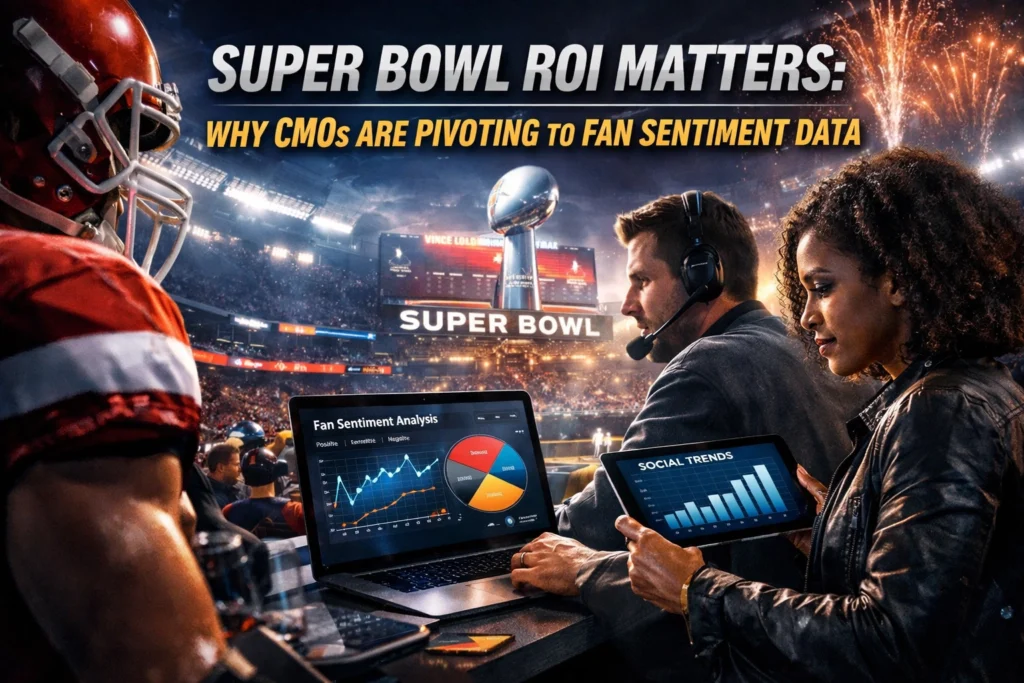
The Super Bowl is the undisputed heavyweight champion of the marketing world. Every year, brands shell out record breaking amounts of cash for 30 seconds of fame. In 2026, the stakes are higher than ever. But here is the cold, hard truth that keeps Chief Marketing Officers (CMOs) up at night. Winning the "Ad Meter" does not mean you are winning at the bank.
For years, the industry relied on "likability" scores. If people laughed at your commercial or if a puppy made them cry, the campaign was a success. However, recent data suggests that there is almost zero correlation between how much people like an ad and how much they actually buy from the brand. This disconnect is causing a massive strategic pivot. Today, forward thinking CMOs are moving away from surface level vanity metrics and diving deep into fan sentiment data.
The Super Bowl ROI Paradox
Let’s talk numbers. A 30 second spot now costs north of $7 million just for the airtime. When you factor in world class production, celebrity talent, and the mandatory digital "companion buys" required by networks, most brands are looking at a total bill of $20 million to $30 million.
That is a staggering investment. While some reports suggest an average return of $5.20 for every dollar spent, those figures often ignore the massive "all in" costs. Research from Georgia Southern University recently highlighted a glaring issue. USA Today Ad Meter scores, which rank ads by popularity, have no significant relationship with financial effectiveness.
In other words, you can have the most popular commercial in the world and still see your stock price dip or your sales remain flat. This is the ROI paradox. The "buzz" is temporary, but the bill is permanent.

Why Fan Sentiment is the New Gold Standard
So, if traditional metrics are failing, what are CMOs looking at? They are looking at how fans actually feel and interact with the brand over time. This is where fan sentiment data comes into play.
Unlike a simple "thumbs up" or "thumbs down," sentiment data analyzes the emotional connection a consumer has with a brand. Is the audience feeling a sense of nostalgia? Are they feeling inspired? Or are they just annoyed by the interruption?
In 2025, we saw a 7% increase in nostalgia based appeals. Why? Because nostalgia creates a safe emotional harbor for consumers. When a brand taps into that feeling, the "sentiment" is positive and long lasting. It lingers far longer than a quick laugh.
CMOs are now using AI driven tools to monitor social conversations in real time. They aren't just looking at the number of mentions, they are looking at the quality of those mentions. If 10,000 people tweet about your ad but 8,000 of them are complaining about the brand's values, your ROI is in the gutter, regardless of the viewership numbers.
Strategic Insights for the Modern CMO
If you are leading a marketing department, your strategy cannot begin and end with the 30 second spot. The spot is no longer the centerpiece. It is the launch event.
The real winners of the Super Bowl are the brands that activate their audiences before, during, and after the game. This is what we call "full funnel" activation. You need to build anticipation in the weeks leading up to the game and have a robust plan to keep the conversation going for the 28 days following the Big Game.
Check out this strategic breakdown on how ROI and sentiment are shifting in our latest Super Bowl Blitz update:
https://www.youtube.com/watch?v=l6J-0zileKE
The Role of NIL and Athlete Influence
One of the most effective ways to drive positive fan sentiment is through Name, Image, and Likeness (NIL) partnerships. Fans may be skeptical of a massive corporation, but they trust the athletes they follow every day.
By leveraging athletes who already have an established, positive sentiment with their fanbase, brands can "borrow" that trust. This is a much more surgical approach than a broad, expensive TV spot. When an athlete shares a behind the scenes look at a brand partnership on their personal social media, the engagement is often higher and the sentiment is significantly more authentic.
At Name. Image, likeness., we specialize in bridging this gap. We help brands identify the right athletes who align with their core values, ensuring that the sentiment data remains high and the ROI follows suit. You can explore our marketplace here: https://mysportsmedia.com/nil.

Beyond the Traffic Spike
We have all seen the data. A Super Bowl ad can cause a traffic spike of 24,000% in the minutes after it airs. But what happens an hour later? Or a week later?
On average, advertisers only see about a 1% increase in traffic over the 28 day period following the game. That is a lot of money for a very temporary spike. The goal for CMOs now is to convert that temporary "blitz" into a permanent "community."
This is achieved by focusing on engagement scores. Are people clicking through to learn more? Are they signing up for newsletters? Are they engaging with the NIL athletes associated with the campaign? If the answer is no, then the $30 million was likely wasted.
Tips for Maximizing Your Marketing Spend
If you want to ensure your marketing budget delivers high performance, consider these steps:
- Prioritize Sentiment Over Reach: It is better to reach 1 million people who love your message than 100 million who are indifferent to it.
- Invest in Long Term Content: Don't put all your eggs in the 30 second basket. Build a content ecosystem that supports your campaign for months.
- Use Data, Not Gut Feelings: Use sentiment analysis tools to see how your audience is reacting in real time and be ready to pivot your digital messaging accordingly.
- Leverage NIL Early: Start your athlete partnerships months before the Big Game to build a foundation of trust and authenticity.
For those looking to dive deeper into how NIL can revolutionize your brand's reach, check out our program details here: https://affilate.mysportsmedia.com/nil-program-details.
Frequently Asked Questions (FAQ)
What is the average ROI for a Super Bowl ad?
While some reports suggest a return of $5.20 per dollar spent, this varies wildly. Many brands struggle to reach a positive ROI once total production and activation costs (often $20-30 million) are included.
Why is fan sentiment data more important than viewership numbers?
Viewership only tells you how many people potentially saw your ad. Sentiment data tells you if they liked it, if they trust your brand, and if they are likely to buy from you. High viewership with negative sentiment can actually damage a brand.
How does NIL help with Super Bowl marketing?
NIL allows brands to use the personal influence of athletes to reach fans on a more authentic level. This often results in higher engagement and more positive sentiment than traditional television advertising.
Is the 30 second spot still worth it?
Only if it is part of a larger, comprehensive strategy. As a standalone tactic, it is increasingly difficult to justify the cost for most brands. It works best as a "launch event" for a multi channel campaign.
Connect With Us
We are here to help you navigate the complex world of digital marketing, athlete branding, and high performance ROI. Whether you are a brand looking for the perfect NIL partner or an athlete looking to build your business, we have the tools you need.
Dan Kost, CEO
Email: info@MySportsMedia.com
Website: mysportsmedia.com/nil
Contact: Reach out via our website for direct inquiries.
Don't forget to share this post and join the conversation!
Share on:
[Facebook] | [Instagram] | [LinkedIn] | [X]
#HighPerformance

The shift is clear. The era of "advertising for the sake of advertising" is over. CMOs are now the architects of sentiment, using data to build real relationships with fans. If you aren't looking at the sentiment data, you aren't seeing the whole picture. And in the high stakes world of the Super Bowl, what you don't see can cost you everything.

