


So, you just dropped $8 million on a 30-second spot. Or maybe you’re the CMO who decided to "sit this one out" and spend that budget on a massive influencer and NIL campaign instead. Either way, the dust has settled on Super Bowl LX in early 2026, and the board of directors is asking one question. Was it worth it?
The Super Bowl is no longer just a football game. It is a 72-hour cultural earthquake. In 2026, we saw something we haven't seen in a decade. A pricing plateau. After years of vertical climbs, the price for a 30-second slot held steady at $8 million. This suggests that brands are finally demanding more than just "eyeballs." They want actual, measurable ROI.
In this guide, we’re breaking down why the $8 million headline is a myth, how to measure real financial success, and why the 72-hour content ladder is the only way to survive the post-game scrutiny.
The Myth of the $8 Million Price Tag
If you’re telling your CFO that the campaign cost $8 million, you’re already in trouble. That’s just the "rent" for the airwaves. When you factor in top-tier production, A-list talent, digital amplification, and the massive PR machine required to make the ad "go viral," the true investment often triples.
For most brands in 2026, the total cost of a Super Bowl campaign sits closer to $15 million to $20 million. To see a return, your strategy cannot start and end with a TV broadcast. You need a multi-platform approach that captures attention before the coin toss and keeps it long after the trophy is raised.

A photo-realistic image of a modern corporate marketing war room where CMOs and data analysts are looking at real-time social media engagement metrics on large wall-mounted screens.
ROI by the Numbers: Is it Worth the Spend?
The data from early 2026 is clear. Super Bowl ads are approximately 20 times more effective than regular television advertising on a per-dollar basis. But there is a massive catch.
Industry analyses show that the average ROI for a full-cycle Super Bowl campaign is about $5.20 for every $1 invested. Some brands do even better. Take the classic Budweiser case study. By using an integrated approach across 55 media markets, they saw a 15.75% revenue lift per household in the weeks following the game. That translated to roughly $96 million in incremental sales.
However, there’s a growing disconnect in the 2026 market. People are getting harder to please. Data shows that 2026 ads were 9% less likely to "amuse" the audience compared to 2025. This creative fatigue means that if you aren't doing something radically different, you’re just background noise.
The Trap: Likeability vs. Effectiveness
Here is the hard truth for every marketing department. Winning the "Ad Meter" does not mean you won the Super Bowl.
Research from Georgia Southern and other major institutions has found that there is almost zero correlation between how much people "like" an ad and how much they "buy" the product. You can have the funniest, most shared commercial of the night and still see a flat line on your sales chart.
CMOs need to stop chasing "likes" and start chasing "intent." Are people searching for your brand? Are they signing up for your newsletter? Are they clicking the links in your bio?
Check out our deep dive into the strategic shifts in sports marketing here:
https://www.youtube.com/watch?v=l6J-0zileKE
The 72-Hour Playbook for Super Bowl Success
To truly dominate the ROI game, you have to look at the 72-hour window surrounding the event. This is what we call the "Content Ladder."
Layer 1: The Attention Phase (The Immediate Window)
This is the broadcast itself. You are looking for search lift. Did your branded keywords spike on Google? Did your website handle the traffic? In 2026, peak social engagement occurred around 9:30 p.m. ET with over 28 million engagements. If you weren't ready to capture those leads in real-time, you lost money.
Layer 2: The Engagement Phase (The Morning After)
This is where you track brand sentiment and social conversation. In Super Bowl LX, Pepsi and Apple Music led the charge in mentions. But the real winners were the brands that used retargeting. If someone engaged with your ad on X (formerly Twitter) or Instagram, did they see a follow-up offer on Monday morning?
Layer 3: The Conversion Phase (Weeks 2–6)
This is the "make or break" period. This is where you measure incremental sales in test markets versus control markets. It is where you look at your customer acquisition costs. If your Super Bowl spend didn't lower your long-term CAC, it was an expensive vanity project.
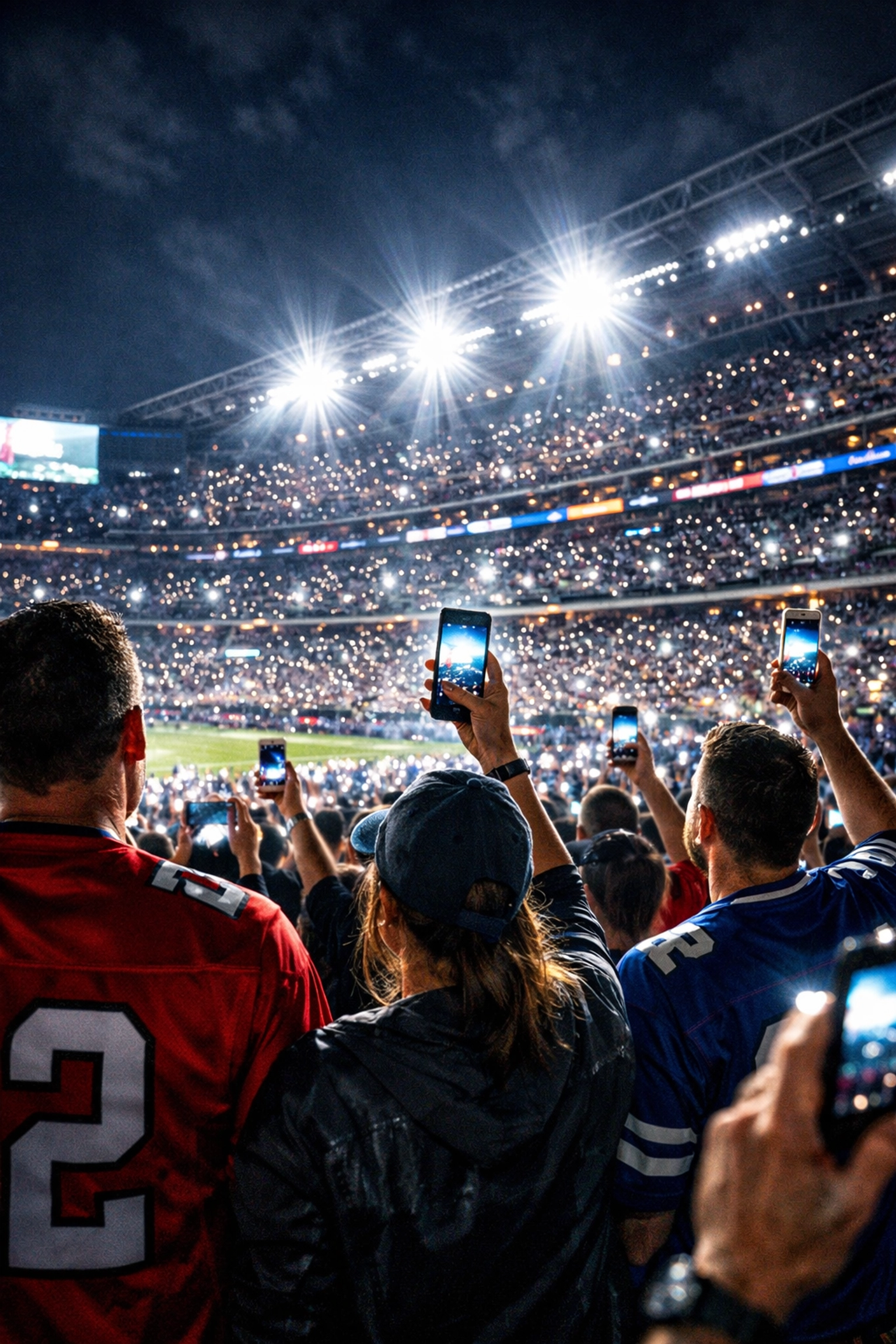
A high-resolution photo of a stadium crowd in 2026, with thousands of fans holding up their glowing smartphones, capturing the intersection of live sports and digital engagement.
The NIL Revolution: Athlete Branding is the New TV Spot
In 2026, the biggest shift we’ve seen isn't in the ads themselves, but in who is delivering the message. Name, Image, and Likeness (NIL) has changed the game. Brands are no longer just hiring celebrities. They are partnering with the athletes who have direct, authentic connections with their fans.
Using an athlete’s NIL during the Super Bowl window provides a level of "earned media" that a standard commercial can't touch. When a player posts behind-the-scenes content or endorses a product during the Super Bowl blitz, the engagement rates are significantly higher than traditional brand posts.
At Name. Image, likeness., we specialize in connecting brands with these high-performance opportunities.

If you want to see how NIL can drive your ROI beyond the 30-second spot, check out our marketplace: https://mysportsmedia.com/nil.
Social Media and Earned Value
Super Bowl LX generated a staggering $550 million in earned media value across social platforms. With over 764 billion potential impressions, the game remains the single greatest attention-grabbing event on the planet.
But notice the trend. The brands that won weren't just the ones with the biggest TV budgets. They were the ones that owned the social narrative. They used creators, athletes, and real-time responses to stay in the conversation.

A photo-realistic image of a professional athlete in a high-performance training environment, representing the power of personal branding and NIL in modern marketing.
FAQ: What CMOs are Asking About Super Bowl ROI
Q: Is the $8 million price tag for a 30-second spot going to keep rising?
A: Actually, the 2026 plateau suggests we are hitting a ceiling. Experts predict prices will stabilize between $8M and $10M through 2030 as brands demand better data and more integrated digital components.
Q: How do I measure ROI if my product isn't an impulse buy?
A: Focus on "Layer 3" of the playbook. Look at the 6-week window post-game. Track brand lift, search volume, and the performance of your retargeting audiences.
Q: Should I use a celebrity or an athlete for my campaign?
A: Athletes often provide a better ROI because of the "authentic fan" connection, especially when leveraging NIL platforms. Celebrities offer broad reach, but athletes offer deep engagement.
Closing Thoughts: The Future of the Blitz
The Super Bowl will always be the "Big Game," but for CMOs, the game is changing. It is no longer about who can spend the most. It is about who can be the smartest with their 72-hour window. By focusing on conversion over likeability and leveraging the power of athlete branding through NIL, you can turn an $8 million gamble into a guaranteed win.
Stay focused on the data, keep your creative fresh, and never stop retargeting. That is the secret to Super Bowl ROI in 2026.
#HighPerformance
Contact Information
Dan Kost, CEO
Name. Image, likeness. / Sports Media Inc.
Email: info@MySportsMedia.com
Website: mysportsmedia.com/nil
Phone: Contact our office for a direct consultation on your 2026/2027 media strategy.
Share this post:
[Facebook] | [Instagram] | [LinkedIn] | [X]

A clean, professional photo of a high-end tablet displaying a dashboard of sports marketing analytics, with a stadium in the blurred background.

