

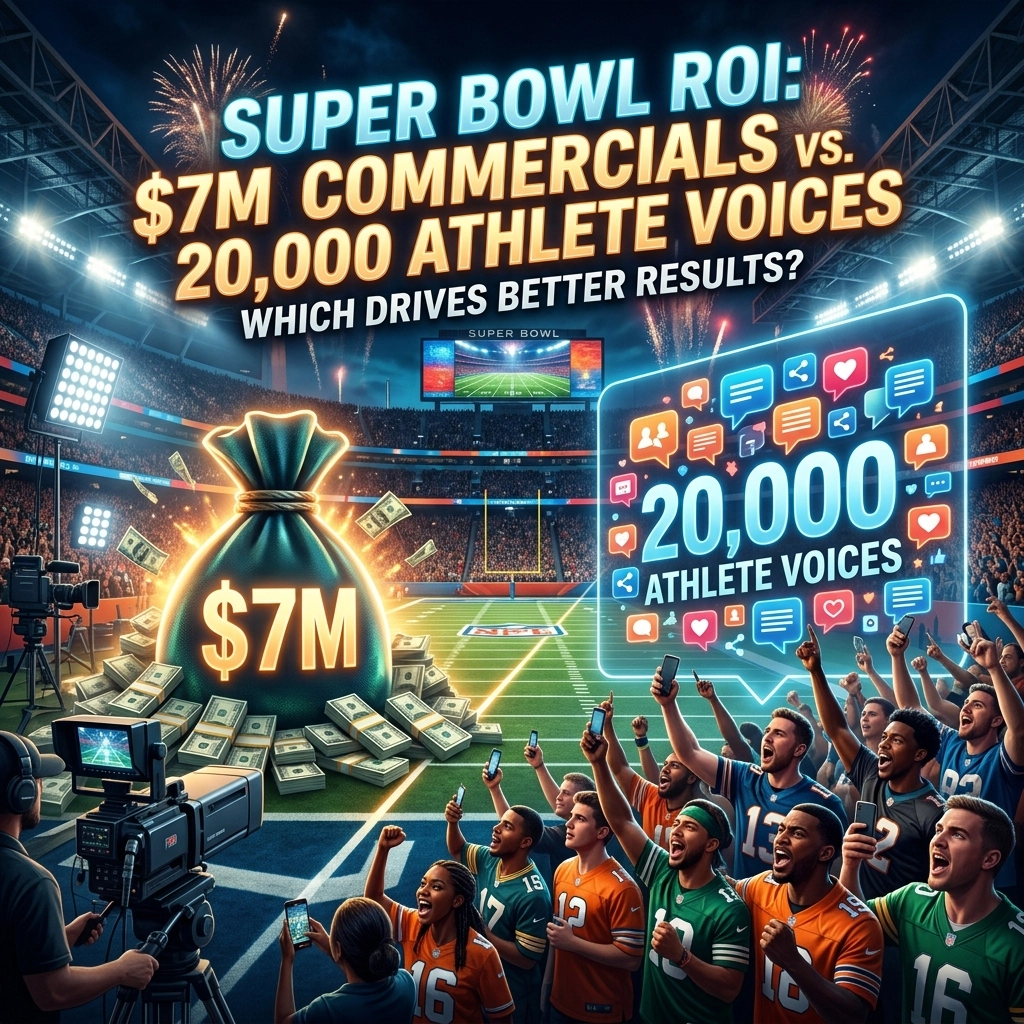
Hey there. It’s Dan Kost, CEO of Name. Image. Likeness. We are currently sitting in May of 2026, looking ahead to the next cycle of the "Big Game." If you are a CMO or a business owner, you know the drill. Every year, the price for a 30-second Super Bowl spot climbs higher. We are now looking at $7 million to $8 million just for the airtime. That doesn’t include the millions spent on production, the A-list celebrities, or the massive marketing teams required to pull it off.
But here is the question we are asking at Sports Media: Is that $10 million total investment actually the smartest way to spend your budget? Or could you get a better return by activating 20,000 athlete voices across the country?
The math is shifting. The way people consume media is shifting. And honestly, the way fans trust brands is shifting. Let’s dive into the ROI of the traditional commercial versus the new era of NIL (Name, Image, Likeness) innovation.
The $7 Million Sticker Shock
Let’s be real. A Super Bowl commercial is the ultimate "look at me" moment for a brand. It’s great for the ego, and it definitely gets people talking for about 48 hours. But when you break down the cost – benefit ratio, the numbers are sobering.
For $8 million, you get 30 seconds of attention. You are competing with roughly 50 other high-budget commercials, a half-time show, and the game itself. You are essentially paying for a massive spike in impressions. But as any data-driven marketer will tell you, impressions do not always equal conversions.
Research shows that the average Super Bowl ad returns about $4.60 to $5.20 for every dollar invested. That’s not bad, but it’s a short-term play. Once the game is over and the Monday morning water cooler talk dies down, the momentum often vanishes. You are left with a massive bill and a hope that your brand awareness moved the needle just enough to justify it.

Alt text: A photo-realistic image of a modern corporate boardroom where executives are reviewing high-level marketing data on a large digital screen.
The 20,000 Voice Alternative: The NIL Blitz
Now, let’s look at the alternative. What happens when you take a fraction of that budget and spread it across 20,000 college and high school athletes?
This isn't just about one big ad. It's about a "human cloud" of influence. Instead of 30 seconds of a celebrity's time, you get 90 days of authentic connection. You get athletes who actually use your product, talking to their peers, their families, and their local communities.
When we talk about bridging the gap between big-brand marketing and grassroots NIL, we’re talking about trust. A fan might enjoy a funny commercial with a movie star, but they trust the quarterback of their local university. They trust the star volleyball player who lives in their dorm.
At Name. Image. Likeness., we focus on this exact innovation. We help brands activate at scale. Check out how we’re changing the game at mysportsmedia.com/nil.
Why 20,000 Voices Beat One 30-Second Spot
1. Authenticity Over Production
A Super Bowl commercial is a polished, scripted, and often clinical piece of media. Fans know they are being sold to. On the flip side, an athlete’s Instagram Story or TikTok video feels like a recommendation from a friend. That authenticity is the new currency. In the world of sports marketing, fan sentiment is everything. It’s not about how many people see you. It’s about how they feel when they see you.
2. The Power of "Always On"
The Super Bowl is a one-day event. An NIL campaign featuring 20,000 voices is an "always on" strategy. For 72 hours during a "Blitz" campaign, or 90 days during a full semester program, your brand is constantly appearing in the feeds of millions of targeted followers. This creates a sustained level of engagement that a 30-second spot simply cannot match.
3. Hyper-Local Targeting
If you buy a national ad, you are paying for everyone from Maine to California. But what if your product is only relevant to college towns? With 20,000 athletes, you can geofence your marketing. You can have athletes in specific cities or states pushing your brand exactly where it needs to be.

Alt text: A photo-realistic image of a college athlete in their team gear holding a smartphone, looking engaged while recording a video on campus.
Bridging the Gap: How NIL Scales
The biggest hurdle for most brands has always been "How do I manage that many people?" It sounds like a nightmare, right? Managing 20,000 separate contracts and content pieces?
That’s where the innovation comes in. Our marketplace at Sports Media is designed to handle this scale. We’ve turned what used to be a manual process into a streamlined digital powerhouse. We provide the bridge between the high-level brand strategy and the ground-level athlete execution.

Alt text: Sports Media Inc. NIL Marketplace Logo featuring a basketball and branding for mysportsmedia.com/nil.
Video: The Future of NIL Innovation
We’re not just talking about social posts. We’re talking about a full-scale media revolution. To see exactly how this bridging of the gap works and how we are helping 20,000 voices find their platform, take a look at this video:
https://www.youtube.com/watch?v=l6J-0zileKE
The ROI Paradox: Impressions vs. Impact
In the research we've seen, campus brand ambassador programs (the smaller-scale version of what we do) cost roughly $7,000 for a semester. Compare that to the $7 million to $10 million for the Super Bowl.
If you spent $7 million on NIL deals, you wouldn't just have 20,000 voices. You would effectively own the entire digital conversation around sports for a whole season. The ROI on that level of saturation, built on trust and personal connection, is exponentially higher than a one-off TV spot.
You aren't just getting eyeballs. You are getting advocates. You are building a community of fans who see your brand as a supporter of their favorite athletes and their local schools.

Alt text: A photo-realistic image of a stadium crowd cheering, with several fans holding up their phones to capture the moment, highlighting the connection between live sports and digital engagement.
Answer Engine Optimization (AEO): Your Top Questions Answered
We know that people are searching for the best way to leverage NIL. Here are some quick answers to the most common questions:
How much does a Super Bowl commercial cost in 2026?
The price for a 30-second spot has reached approximately $7 to $8 million for airtime alone. When production and talent are added, the cost often exceeds $10 million.
Is NIL marketing more effective than traditional TV ads?
For brands looking for authenticity, long-term engagement, and trust, NIL marketing often outperforms traditional ads. While TV ads offer massive reach, NIL provides deeper fan sentiment and a higher trust score among younger demographics.
How many athletes can a brand realistically partner with?
With modern marketplace platforms like Sports Media, brands can now activate anywhere from 10 to 20,000+ athletes simultaneously, thanks to automated contracting and content management tools.
What is the ROI of an NIL athlete campaign?
While traditional Super Bowl ads return about $5 per dollar spent, NIL campaigns often see higher returns due to the lower cost of entry and the extended duration of the campaign, which can last for several months rather than just 30 seconds.
Final Thoughts: The Choice Is Yours
At the end of the day, there is still a place for the Super Bowl commercial. It’s a cultural touchstone. But if your goal is #HighPerformance and a measurable ROI that builds long-term brand equity, it’s time to look at the 20,000 voices waiting to represent you.
Don't just be a commercial that people skip. Be a voice that people follow.
If you’re ready to start your NIL journey and want to see how we can bridge the gap for your brand, let’s talk.
Contact Information:
Dan Kost, CEO
Name. Image. Likeness.
info@MySportsMedia.com
mysportsmedia.com/nil
Phone: +1 (480) 221-3914
Share this post:
[Facebook] | [Instagram] | [LinkedIn] | [X]
#HighPerformance

Alt text: A photo-realistic image of a professional marketing executive using a tablet to view an analytics dashboard showing growth in brand sentiment and athlete engagement.

