

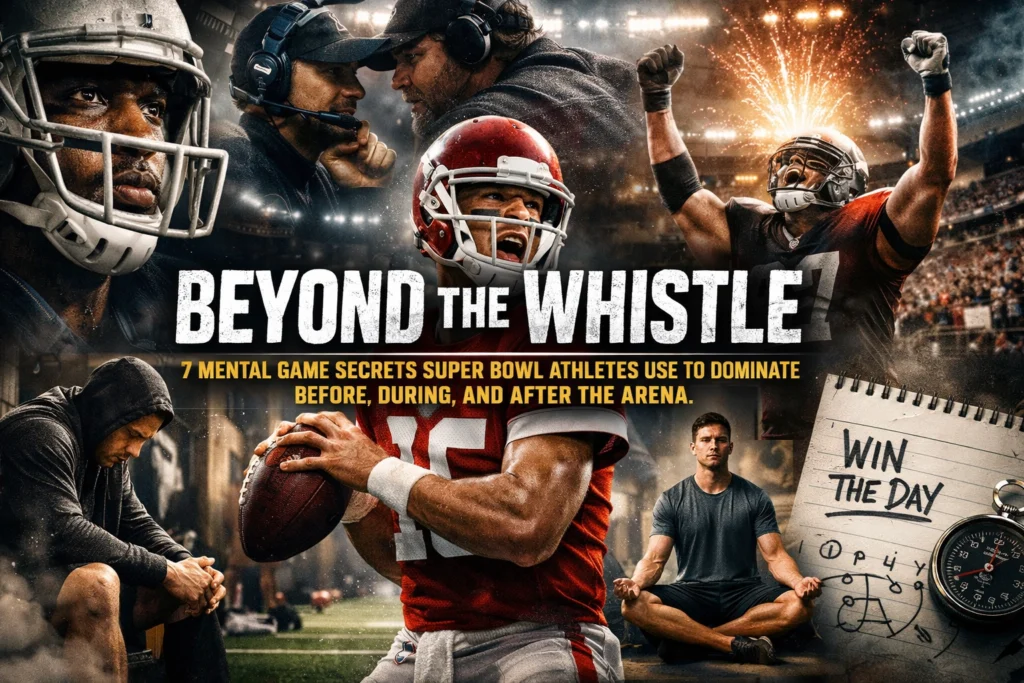
The Super Bowl isn't just won on the field. It's won in the mind. Long before the first snap, elite athletes are already working on the most critical muscle in their body: the one between their ears.
Whether you're a high school athlete grinding toward your first championship, a college player eyeing the pros, or a coach looking to unlock your team's full potential, the mental strategies Super Bowl athletes use can transform how you perform when it matters most.
Let's dive into seven mental game secrets that separate good athletes from dominant ones, before, during, and after game time.
Before the Arena: Setting the Mental Foundation
1. Visualization That Actually Works
You've probably heard about visualization, but here's the twist: elite athletes don't just imagine themselves winning. They rehearse steadiness.
Super Bowl quarterbacks don't visualize throwing perfect passes every time. They picture themselves staying calm after an interception, refocusing after a missed opportunity, and maintaining composure when the defense brings unexpected pressure.
This type of mental rehearsal strengthens neural pathways and reinforces muscle memory. Your brain doesn't know the difference between a vividly imagined experience and a real one. When you mentally practice staying cool under pressure, you're literally training your nervous system to respond that way when the moment arrives.
Your Move: Spend 10 minutes before bed visualizing how you'll respond to adversity tomorrow. See yourself bouncing back from mistakes with confidence.

2. Focus on the Process, Not the Outcome
Here's a truth bomb: the moment you start obsessing over winning, you've already lost mental control.
Elite athletes focus on execution, not results. They concentrate on what they can control: their footwork, their breathing, their next play, their communication with teammates. They let go of outcome expectations and the pressure to be perfect.
When you shift from "I have to win" to "I'm going to execute my fundamentals flawlessly," you free yourself from the mental prison of overthinking. Overthinking is what causes athletes to choke. The ones who dominate stay present.
Your Move: Before your next competition, write down three process-based goals (like "communicate on every play" or "maintain perfect form on free throws") instead of outcome goals.
3. Protect Your Sleep Like Your Career Depends On It
Because it does.
Sleep is often the first thing athletes sacrifice under pressure. Late-night film study, anxiety-driven insomnia, inconsistent schedules – these are performance killers.
Super Bowl athletes guard their sleep fiercely. They understand that mental sharpness, reaction time, and emotional regulation all depend on quality rest. Consistent sleep schedules and pre-sleep routines signal safety to your nervous system, keeping stress hormones in check.
Your Move: Set a non-negotiable bedtime for the week before competition. Create a simple wind-down routine (no screens 30 minutes before bed, same stretching sequence, calming music) and stick to it religiously.
During the Arena: Staying Sharp When It Counts

4. Master Box Breathing to Control Your Nervous System
When the pressure spikes, your body goes into fight-or-flight mode. Your heart races, your thoughts scatter, and suddenly you're playing reactive instead of dominant.
Elite athletes use box breathing to hijack this response:
- Inhale for 4 seconds
- Hold for 4 seconds
- Exhale for 4 seconds
- Hold for 4 seconds
- Repeat
This simple technique quickly calms your nervous system. Navy SEALs use it before missions. Super Bowl athletes use it during timeouts and between plays.
Your Move: Practice box breathing during practice this week. Make it automatic so you can deploy it instantly when game pressure hits.

5. Acknowledge Your Emotions Instead of Suppressing Them
Nervous before the big game? Good. That means you care.
The biggest mental game mistake athletes make is trying to shut down their emotions completely. Suppression backfires, creating more internal pressure and self-monitoring anxiety.
Elite performers acknowledge their nerves without judgment. "I'm feeling anxious right now, and that's okay. It means this matters to me." Then they redirect that energy into focused action.
Your Move: Next time you feel pre-game jitters, say out loud: "I'm nervous because I care, and I'm ready to use this energy." Then take three box breaths and get to work.

6. Talk to Yourself Like You'd Talk to Your Best Friend
Your internal dialogue during competition directly impacts your confidence and execution.
When a Super Bowl linebacker misses a tackle, they don't tell themselves, "You're terrible, you always mess up." They use realistic, positive self-talk: "Next play. I know what I need to do. Lock in."
This isn't toxic positivity. It's strategic confidence control. You wouldn't destroy your teammate's confidence with negative self-talk, so why do it to yourself?
Your Move: Catch yourself using negative self-talk this week. Immediately replace it with what you'd say to encourage a teammate in the same situation.
After the Arena: Recovery and Mental Reset
7. Protect Your Identity Beyond the Sport
Here's the hard truth: your value as a human being isn't determined by your performance in any single game, season, or career.
Elite athletes maintain strong connections with people who see them as more than players. Family, friends outside sports, hobbies, faith communities – these relationships remind them that their identity extends beyond the arena.
This isn't about caring less. It's about building a foundation that can weather any performance outcome. Athletes with strong non-sport identities bounce back faster from defeats and handle success with more grace.
Post-competition, the best athletes also:
- Limit media consumption and external commentary
- Prioritize deliberate recovery including quality sleep
- Journal about what they learned
- Seek professional mental health support when needed
Your Move: Identify three people in your life who value you independent of your athletic performance. Spend intentional time with them this week.

The Bottom Line: Mental Toughness Is a Skill, Not a Gift
Mental toughness isn't about being emotionless or fearless. It's about managing pressure through awareness, controllable actions, and recognition that seeking support strengthens rather than weakens performance.
The seven secrets we've covered aren't just for Super Bowl athletes. They're for anyone who wants to perform at their highest level when it matters most. Whether you're competing for a state championship, building your NIL brand, or coaching the next generation of athletes, these mental strategies give you a competitive edge.
Start implementing one or two of these secrets this week. Build your mental game deliberately, just like you build your physical skills. Your mind is the most powerful tool you have – it's time to train it like one.
Ready to elevate your mental game and your brand? Name. Image, Likeness. helps athletes and coaches build their digital presence and maximize their NIL opportunities. Learn more about our NIL program at https://mysportsmedia.com/nil or explore detailed program information at https://affilate.mysportsmedia.com/nil-program-details.
Contact Dan Kost, CEO
Email: info@MySportsMedia.com
Website: mysportsmedia.com/nil
Share this post:
Facebook | Instagram | LinkedIn | X (Twitter)
#HighPerformance #MentalToughness #AthletesMindset #SuperBowl #SportsPerformance #NIL #CoachingTips #AthleteBranding

