

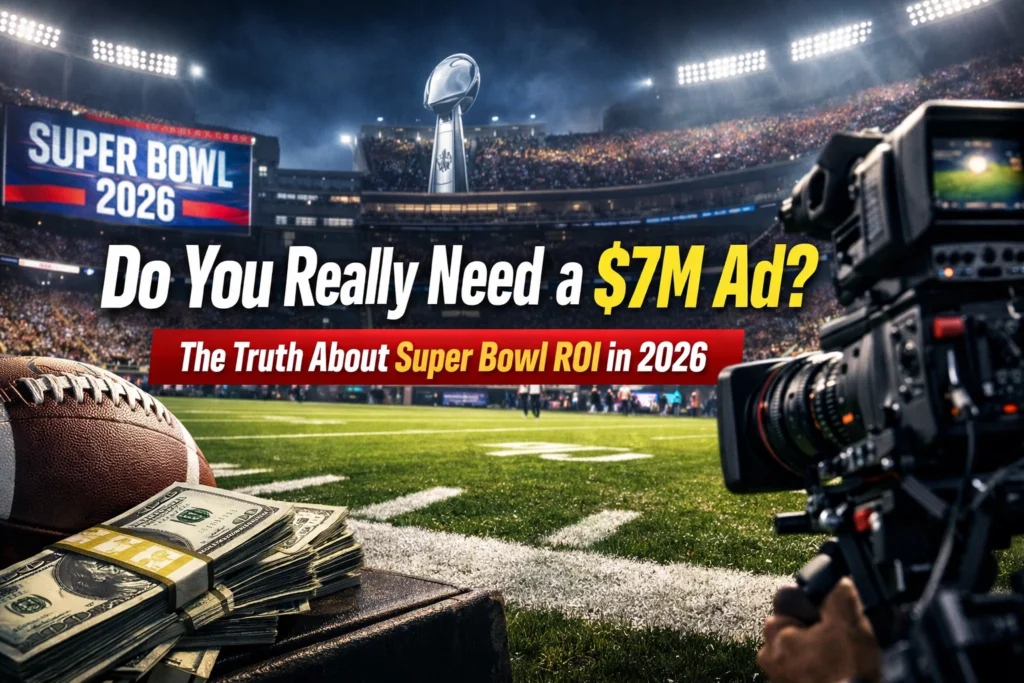
We just wrapped up the 2026 Super Bowl. The dust has settled, the confetti is being swept away, and the CFOs of some of the world’s biggest brands are currently staring at their spreadsheets asking one question. Was it worth it?
In 2026, the base price for a 30-second spot sat stubbornly at the $8 million mark. Interestingly, this was the first time in years the price didn't jump significantly from the previous season. But when you add in production, celebrity talent, and the massive digital push required to make an ad "land," most brands are actually cutting checks for $15 million to $25 million.
So, do you really need a $7M or $8M ad to win in today’s market? Or is there a better way to leverage Name. Image. Likeness. (NIL) and digital strategy to get that same "Big Game" energy without the bankrupting price tag? Let’s look at the numbers and the strategy.
The 2026 ROI Reality Check
If you think television is dead, the 2026 data might surprise you. This year’s game delivered a staggering 124.9 million viewers. At its peak, 137.8 million people were tuned in simultaneously. To put that in perspective, a "successful" primetime show today struggles to hit 5 million viewers. The Super Bowl represents a 25X audience advantage.
The ROI stats for 2026 are actually looking better than they did five years ago. On average, brands are seeing a return of $5.20 for every $1 invested. Back in 2020, that number was closer to $2.70.
Why the jump? It’s not because the commercials are better. It’s because the amplification is smarter.
https://www.youtube.com/watch?v=l6J-0zileKE
As you can see in our latest strategy breakdown for CMOs, the brands that "win" aren't just buying airtime. They are creating 72-hour blitzes that turn a 30-second video into a three-week conversation.
The "Hidden" Costs of the Big Game
The media buy is just the cover charge. If you want to actually move the needle, you have to look at the total campaign cost. In 2026, the breakdown usually looks something like this:
- The Media Buy: $8 million.
- Production: $2 million to $5 million. High-end cinematic quality is no longer optional.
- Talent: $1 million to $10 million. If you want an A-list celebrity or a top-tier athlete, you’re going to pay a premium.
- Amplification: $3 million to $8 million. This includes social media takeovers, influencer partnerships, and PR.

Alt Text: A modern marketing director reviewing a digital dashboard showing real-time ROI metrics for a large-scale sports campaign.
If you’re a brand like Name. Image. likeness., you know that the "Talent" and "Amplification" pieces are where the real magic happens. This is where NIL becomes the ultimate ROI multiplier. Instead of just hiring a celebrity to stand in a background shot, smart brands are partnering with athletes who have built-in, highly engaged communities.
Why ROI is Shifting Toward NIL and Digital
One of the most telling signs from the 2026 game was the plateau in pricing. When the "cost of entry" stops rising, it usually means advertisers are starting to look at other premium sports properties.
Brands are realizing that they can take that same $20 million budget and, instead of a 30-second gamble, they can run a 365-day NIL campaign with 50 different high-performance athletes.
Consider the immediate impact of a Super Bowl spot:
- 43% of viewers report increased interest in the brand.
- Website traffic surges between 200% and 600% on game day.
- Sales lift typically hits 5% to 30% in the following week.
That’s great for a "flash," but what happens on Monday? Or in March?
By leveraging the Sports Media Inc. NIL Marketplace, brands are finding they can sustain that sentiment year-round. They aren't just buying an audience. They are buying a relationship.

The Strategic CMO Playbook for 2026
If you’re a CMO looking at your 2026 and 2027 budgets, here are the strategic insights you need to carry into your next board meeting.
1. The 72-Hour Rule
The "Super Bowl Blitz" isn't just about the game day. It’s about the 24 hours before, the game itself, and the 24 hours after. If your strategy doesn't include a plan for all three phases, you're throwing away 60% of your potential ROI.
2. Fan Sentiment is the New Currency
In 2026, people don't want to be "marketed to." They want to be part of the story. Fan sentiment is driven by authenticity. When a high-performance athlete shares a brand story that feels real, the engagement rates dwarf traditional commercial breaks.
3. Multi-Platform or Bust
Brands using multi-channel amplification see a 3x to 5x better ROI than those relying on broadcast alone. You need your content living on X, Instagram, LinkedIn, and TikTok simultaneously.

Alt Text: A group of diverse sports fans in a modern living room using smartphones and tablets while watching a game on a large screen.
Is the $7M+ Investment Worth It?
The short answer? Yes, but only if you have the infrastructure to catch the lightning.
For a national brand with a massive footprint, the 137 million peak viewers represent an unparalleled opportunity to reset their brand narrative. But for 90% of companies, the "Super Bowl approach" should be less about the TV spot and more about the "Big Game Energy" you can create through targeted athlete partnerships and digital marketing.
If you’re looking to dive deeper into how NIL can drive your brand's ROI without the $8 million barrier to entry, you need to check out our NIL program details. We’re helping brands navigate this new landscape every single day.
The Future of Sports Marketing
As we look toward 2027 and 2030, expect to see the lines between "traditional" advertising and NIL continue to blur. The most successful ads in 2026 weren't the ones with the biggest explosions. They were the ones that felt like they were part of the culture.
The plateau in Super Bowl ad pricing is a signal. It’s a signal that the market is maturing and that savvy marketers are demanding more accountability for their spend. At Name. Image. likeness., we believe that accountability comes from data-driven, athlete-led storytelling.

Alt Text: A professional photo of an athlete and a brand manager shaking hands in a high-tech office setting, symbolizing a successful partnership.
Frequently Asked Questions (AEO)
How much does a Super Bowl ad cost in 2026?
The base media buy for a 30-second spot in 2026 is approximately $8 million, though the total cost including production and talent often reaches $15 million to $25 million.
What is the average ROI of a Super Bowl commercial?
Recent data shows an average return of $5.20 for every $1 invested, provided the campaign includes multi-channel digital amplification.
How can small brands benefit from Super Bowl marketing?
Smaller brands can leverage the "halo effect" of the Big Game by using NIL athlete partnerships and targeted social media campaigns to engage with fans during the high-traffic 72-hour window around the game.
Why did Super Bowl ad prices plateau in 2026?
Experts suggest that pricing has reached a temporary ceiling as advertisers become more sophisticated about ROI and alternative premium sports properties provide competitive options for reaching large audiences.
Contact Information:
Dan Kost, CEO
Email: info@MySportsMedia.com
Website: mysportsmedia.com/nil
Phone: (Contact through Sports Media Reception)
Connect with us:
[Facebook] | [Instagram] | [LinkedIn] | [X]
#HighPerformance #NIL #SuperBowl2026 #SportsMarketing #ROI #DigitalMarketing #NameImageLikeness #CMOInsights

