

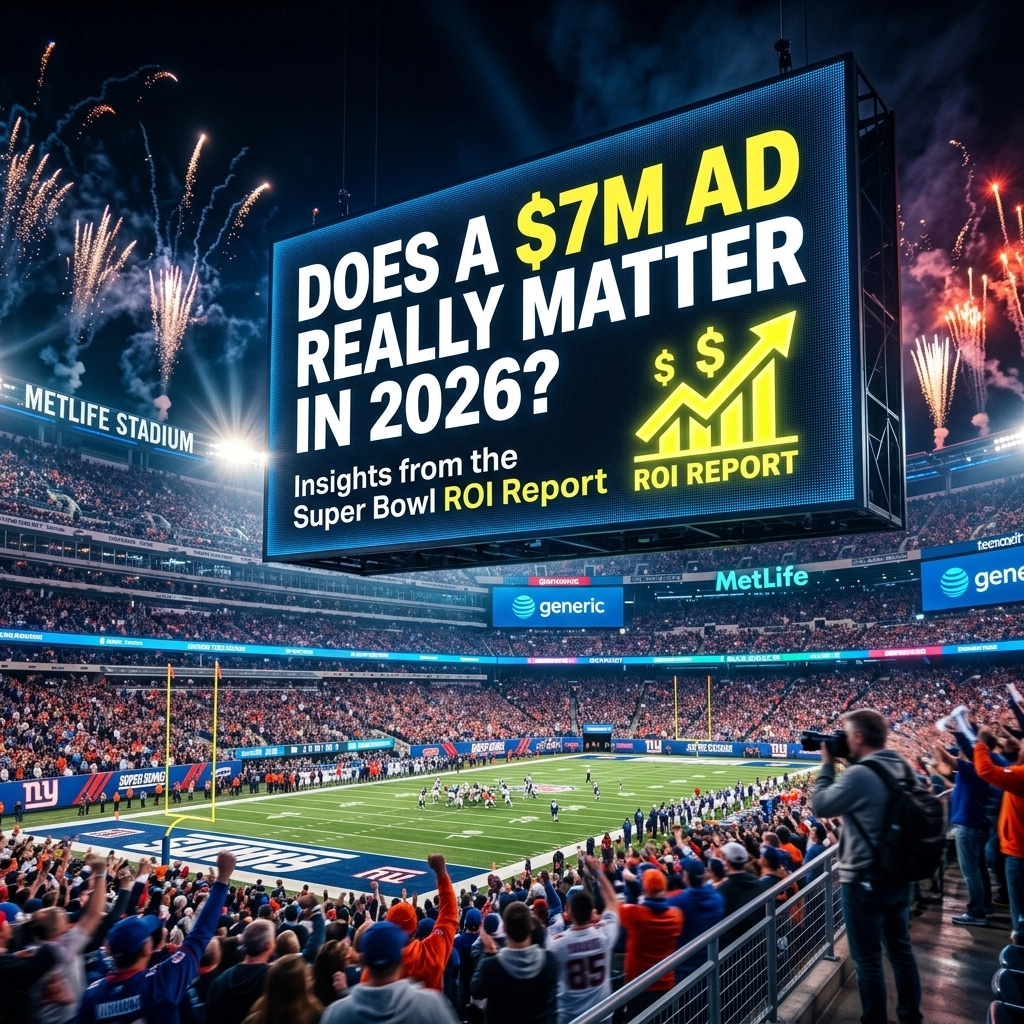
It is February 2026, and the dust has finally settled on the biggest Sunday of the year. While fans are arguing about the officiating, CMOs and marketing directors are staring at their spreadsheets, asking the same $7 million question we hear every single year. Was it worth it?
Actually, in 2026, the price of a 30-second spot has climbed even higher, pushing toward the $8 million mark. But for the sake of the conversation, let’s stick to that iconic $7 million threshold. At Name. Image. likeness., we have been tracking the Super Bowl ROI Report closely. We are seeing a massive shift in how brands perceive value. Is that massive, one-time splash still the gold standard, or are we looking at a relic of a bygone marketing era?
Before we dive into the nitty-gritty numbers, check out our latest Super Bowl Blitz analysis video below. We break down the strategic hits and misses from this year’s Big Game.
https://www.youtube.com/watch?v=l6J-0zileKE
The Economics of the Big Splash
Let’s be real for a second. If you are a massive conglomerate with an annual marketing budget of $500 million, a $7 or $8 million ad is basically a rounding error. For these giants, the Super Bowl isn't just about selling a few more cans of soda or bags of chips on Monday morning. It is an efficiency play.
Economic analysis from 2026 shows a very nuanced ROI picture. If a large company hits their target of a 1% improvement in overall marketing efficiency over 12 months, that Super Bowl ad pays for itself. They only need to acquire about 125 incremental customers per million viewers in the short term to break even. When you are reaching over 100 million people, those numbers start to look a lot more manageable.
The upside is even more staggering. If that 30-second spot manages to shift brand perception or increase marketing efficiency by just a few percentage points, the long-term value can balloon to $50 million or even $100 million over time. For the "Big Dogs," the downside is capped. Even if the ad is a total dud, it usually only represents a tiny 0.5% to 2.5% decrease in their annual efficiency.
But what about everyone else?

Alt text: A photo-realistic image of a modern marketing executive analyzing complex data charts on a glass screen in a high-tech office.
The 72-Hour Fade
Here is where the data gets interesting for the rest of us. Traditional Super Bowl ad metrics often misrepresent the actual, long-term value for a brand. Yes, the top-performing commercials can deliver a 7x to 10x return on investment. The average is around $5.20 for every dollar spent. That sounds great on paper.
However, the vast majority of that value comes from immediate impressions and a massive spike in brand awareness. In 2026, we are seeing that these spikes are shorter than ever. We call it the "72-Hour Fade." By Wednesday morning, the social media conversation has moved on, the trending hashtags have changed, and the "water cooler" talk has evaporated.
If you spent $8 million to be the talk of the town for three days, you better have a massive infrastructure to capture those leads instantly. For many brands, that just isn't the reality.
The NIL Revolution: Depth Over Breadth
This is where Name. Image. likeness. comes into play. While the Super Bowl is the ultimate "breadth" play, capturing millions of eyeballs for a few seconds, the NIL (Name, Image, and Likeness) space is the "depth" play.
Consider the math. While a Super Bowl spot is pushing $8 million, a high-impact campus ambassador program featuring college athletes can cost as little as $7,000 per semester. Think about that for a second. You could run a thousand localized, high-trust campaigns for the price of one Super Bowl ad.
Research in 2026 shows that these ambassador programs deliver deeper fan sentiment, longer-lasting brand relationships, and significantly higher trust scores. Why? Because a college athlete at a major university isn't just a face on a screen. They are a peer. They are a local hero. When they promote a product on their social channels or at local events, the engagement isn't just a "like." It is a conversation.

Alt text: A photo-realistic image of a college athlete interacting with fans and students on a sunny campus, representing a brand with authentic engagement.
Strategic Insights for CMOs
For the CMOs reading this, the question isn't whether the Super Bowl is "bad." It is about where your next dollar of growth is coming from. If your goal is pure, raw awareness, the Big Game is still king. But if your goal is sustained marketing efficiency and building trust in an era of skepticism, you need to look closer at the ground level.
The Super Bowl excels at building a foundation of awareness. But the real value emerges when you use that awareness to fuel sustained improvements in your marketing funnel. If you aren't following up that $7 million investment with localized, high-trust engagement, you are leaving money on the table.
We recommend a "Blitz" strategy. Use the mass media for the initial hit, but pivot immediately to authentic voices. This is why our marketplace at MySportsMedia.com/NIL has become such a vital tool for brands in 2026. We bridge the gap between "Massive Awareness" and "Meaningful Engagement."

Alt text: Sports Media Inc. NIL Marketplace Logo featuring athlete branding elements and MySportsMedia.com/NIL website.
Measuring What Matters in 2026
In 2026, we are moving away from "vanity metrics." We don't just care about how many people saw the ad. We care about:
- Fan Sentiment: Are people talking about your brand with affinity, or are they just laughing at a joke?
- Trust Scores: Does the consumer believe your brand is authentic?
- Long-Tail Efficiency: Does this investment make my Facebook, Google, and NIL ads perform better six months from now?
The Super Bowl ROI Report makes one thing clear. Standalone channels are dying. The most successful brands in 2026 are those that treat the Super Bowl as a kickoff, not the whole game. They are the ones who understand that a student-athlete with 50,000 loyal followers can sometimes move the needle more effectively than a celebrity with 50 million passive ones.
The Verdict
So, does a $7M ad really matter in 2026?
Yes, but only if it is the start of a story, not the end of one. For the brands that can’t justify the $8 million price tag, the good news is that the alternative is actually more effective for building long-term loyalty. The NIL era has democratized influence. It has allowed brands to build "Super Bowl level" trust on a "campus level" budget.
If you are ready to see how your brand can leverage the power of Name, Image, and Likeness to drive real ROI, let’s talk. The game has changed, and it is time to play to win.
Dan Kost, CEO
Name. Image. likeness.
Email: info@MySportsMedia.com
Web: mysportsmedia.com/nil
Phone: (Contact our office for inquiries)
Join the conversation on social media and share your thoughts on this year’s Super Bowl ROI. Use the hashtag #HighPerformance to connect with our community!
Follow us:
Facebook | Instagram | LinkedIn | X
#HighPerformance
About Name. Image. likeness.
Name. Image. likeness. is a leading digital marketing agency specializing in connecting brands with high-performance athletes. We focus on authentic engagement, data-driven ROI, and the evolving landscape of sports media. Based in the heart of the digital marketing revolution, we help brands navigate the complexities of NIL and modern advertising to achieve lasting results.
FAQ: Super Bowl ROI in 2026
Q: Is the Super Bowl still the best way to reach a mass audience?
A: Yes, in terms of raw numbers, nothing beats the Super Bowl. However, the cost per impression is rising, and the "attention span" of that audience is shrinking.
Q: How does NIL compare to traditional celebrity endorsements?
A: NIL athletes typically offer higher engagement rates and better trust scores because they are viewed as more authentic and relatable than traditional A-list celebrities.
Q: Can small businesses benefit from Super Bowl trends?
A: Absolutely. By using "Super Bowl Blitz" tactics on a local level through NIL athletes, small businesses can capture the excitement of the game without the multi-million dollar price tag.

