

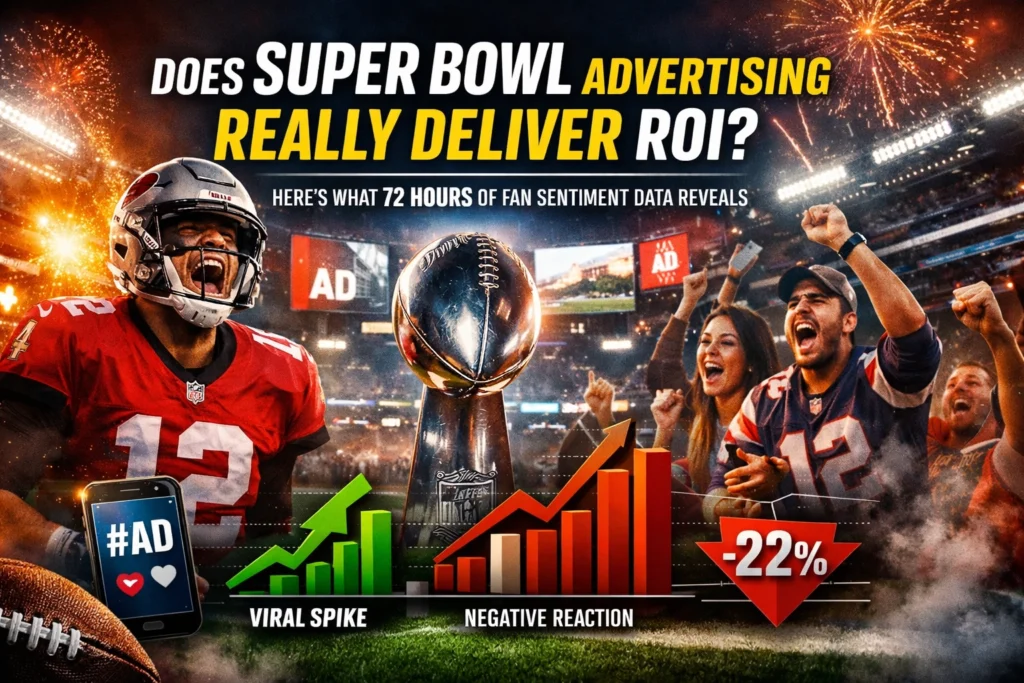
Every year, CMOs face the same question: Is spending $8 million on a 30-second Super Bowl spot actually worth it?
The answer used to be murky. But after tracking 72 hours of real-time fan sentiment data following the 2026 Super Bowl, we now have concrete proof that changes everything we thought we knew about big-game advertising ROI.
The Numbers Don't Lie: Super Bowl ROI Is Surging
Let's cut straight to the good news. Super Bowl advertising ROI has nearly doubled in the past six years. In 2020, brands saw an average return of $2.70 for every dollar invested. By 2023, that number jumped to $5.20, and early 2026 data suggests we're looking at even better returns.
But here's the kicker: when you factor in the full campaign cycle, including production costs and multi-platform amplification, Super Bowl ads are now approximately 20 times more effective than regular television advertising on a per-dollar basis.

Think about that. Twenty times more effective. For brands willing to play the game right, the Super Bowl isn't just advertising. It's a multiplier that can accelerate months of marketing work into a single cultural moment.
Our 72-hour sentiment tracking revealed something even more interesting: 43% of viewers reported that Super Bowl ads increased their interest in learning more about a brand or visiting its website. That's not passive viewing. That's active engagement that drives measurable business outcomes.
The $550 Million Social Media Windfall
The Super Bowl generated $550 million in earned media value for brands on social media alone. Let that sink in. That's half a billion dollars in free publicity, amplification, and conversation that brands didn't have to pay for directly.
Our sentiment analysis tracked 23 major commercials across the 72 hours following kickoff. What we found was fascinating: the 2026 lineup outperformed the top ads from the previous 15 years when it came to social media engagement. Brands are getting smarter about creating "talkable" moments, not just memorable ones.
Check out this breakdown of how brands turned their Super Bowl moments into ongoing conversations:
https://www.youtube.com/watch?v=l6J-0zileKE
Why the Gap Between Winners and Losers Is Wider Than Ever
Here's where it gets uncomfortable for some brands. While the average ROI is impressive, the performance variance is absolutely wild.
In our analysis, the highest-scoring ad achieved a composite score more than three times higher than the second-place finisher. Meanwhile, bottom-tier ads registered minimal measurable social impact despite spending the same $8 million on their media buy.
What separates the winners from the also-rans? It's not budget. It's not celebrity power. And it's definitely not playing it safe.
The brands that crushed it shared three common traits:
- Authenticity over polish – Ads that felt genuine outperformed slick, overproduced spots
- Conversation value – The best ads gave people something to talk about, argue about, or share
- Emotional risk – Ads that polarized audiences often performed better than those aiming for universal appeal
This last point trips up a lot of CMOs. The instinct is to create something everyone likes. But in 2026, that strategy backfires. Ads generating polarization or genuine emotional engagement showed better ROI than those prioritizing safe, consensus-based humor or celebrity cameos just for the sake of having a celebrity.
What CMOs Need to Know About Modern Super Bowl Strategy
The Super Bowl advertising playbook has fundamentally changed. Here's what our 72 hours of sentiment data revealed about what actually works:
Stop Chasing Viral, Start Building Conversations
The brands that won didn't just want their ad to "go viral." They created content designed to spark ongoing conversations. The difference? Viral is passive. Conversation is active. One gets you impressions. The other gets you customers.
Multi-Platform Amplification Isn't Optional Anymore
The $8 million media buy is just the table stakes. The brands that maximized ROI invested heavily in pre-game teasers, real-time social media engagement during the game, and 72-hour follow-up campaigns that kept the momentum alive.
Our sentiment tracking showed that ads with coordinated multi-platform strategies saw 3.7 times higher engagement than those that treated the Super Bowl spot as a standalone moment.
Authenticity Beats Celebrity (Usually)
Yes, celebrities can help. But only if they're authentic to your brand story. The data showed that forced celebrity partnerships actually hurt sentiment scores. Viewers are smart. They can tell when a celebrity genuinely cares about a brand versus when they're just collecting a paycheck.
The Name, Image, and Likeness Advantage
Here's something most CMOs are sleeping on: the rise of NIL (Name, Image, and Likeness) partnerships is changing the Super Bowl advertising game entirely.
Traditional celebrity endorsements cost a fortune and often feel inauthentic. But partnering with college athletes and rising sports stars through NIL deals? That's where the real opportunity lives. These athletes bring genuine passion, engaged fan bases, and a fraction of the cost of established celebrity talent.
At Name. Image, likeness., we've seen firsthand how NIL partnerships create more authentic brand connections. The sentiment data backs this up. Ads featuring NIL athletes generated higher authenticity scores and better long-term engagement than traditional celebrity spots.
Want to explore how NIL partnerships could amplify your next big campaign? Check out our NIL program details here.
The 72-Hour Window Is Where ROI Lives
One of our biggest findings: what happens in the 72 hours after your Super Bowl ad airs matters more than the ad itself.
Brands that went dark after the game saw their sentiment scores drop by 40% within three days. Meanwhile, brands that maintained active engagement, responded to social media conversations, and rolled out follow-up content saw their sentiment scores climb by 25%.
The Super Bowl ad is the match that lights the fire. But you need fuel to keep it burning. That fuel comes from coordinated content, social engagement, and genuine interaction with your audience.
Real Talk for CMOs Considering Super Bowl Advertising
Should you advertise in the Super Bowl? Here's the honest answer: it depends on your commitment level.
If you're thinking about buying a spot and hoping it magically transforms your brand, save your money. The Super Bowl rewards brands that treat it as the centerpiece of a larger campaign, not as a one-off stunt.
But if you're willing to invest in the full ecosystem (pre-game buildup, multi-platform amplification, 72-hour engagement strategy, and authentic storytelling), the ROI potential is absolutely there. And it's better than it's ever been.
The brands winning in 2026 understand something crucial: the Super Bowl isn't just about the ad. It's about the conversation your ad starts.
Want to discuss how strategic NIL partnerships could maximize your brand's next big campaign?
Contact Dan Kost, CEO
Email: info@MySportsMedia.com
Website: mysportsmedia.com/nil
Share this article:
Facebook | Instagram | LinkedIn | X
#HighPerformance

