

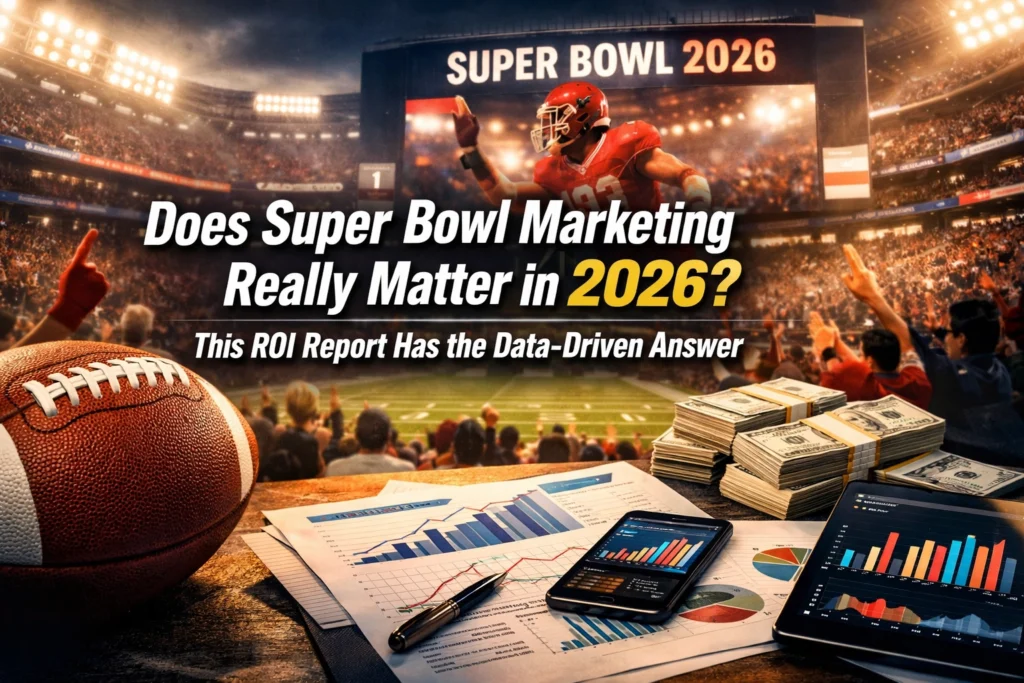
Every February, CMOs across America face the same million-dollar question. Actually, make that an eight-million-dollar question: Is a Super Bowl ad spot worth it?
In 2026, the answer isn't as simple as yes or no. The data tells a more nuanced story, one that could save your brand millions or help you unlock unprecedented reach. Let's break down what the numbers actually reveal.
The Headlines Look Pretty Incredible
First, the good news. Super Bowl LX absolutely crushed it in terms of viewership, pulling in 124.9 million viewers. That's not just a big number, it's a massive audience you literally cannot replicate anywhere else in modern media.
The ROI figures initially seem compelling too. Recent data shows that marketers reported an average return of $5.20 for every dollar invested in Super Bowl advertising. That's a significant jump from $2.70 per dollar back in 2020. On a pure efficiency basis, Super Bowl ads are estimated to be approximately 20 times more effective than regular television advertising on a per-dollar basis.

Plus, there's the cultural impact factor. Super Bowl ads generated an estimated $550 million in earned media value for brands on social media alone. When you create a memorable Super Bowl moment, you're not just buying 30 seconds of airtime, you're potentially creating weeks of conversation, memes, and brand awareness.
And here's another stat worth noting: 43% of viewers report increased interest in learning more about brands they see advertised during the game. That's real audience engagement, not just passive viewing.
But Here's Where the Math Gets Tricky
Now for the reality check that most marketing reports bury in the footnotes.
That $8 million media buy? It's just the beginning. When you factor in production costs, talent fees, agency work, and the full campaign amplification needed to make your spot actually work, true all-in costs typically range from $20-30 million.
Do that math again with the real numbers, and suddenly that $5.20 return per dollar starts looking very different. Many campaigns, when calculated against actual total investment, fail to deliver positive ROI at all.
There's another uncomfortable truth hiding in the data: Super Bowl ad costs have outpaced both inflation and viewership growth over the past five years. Costs are up 43% while audiences haven't grown proportionally. Translation? You're paying significantly more for roughly the same reach.
The $63 CPM (cost per thousand impressions) for Super Bowl advertising sounds reasonable until you compare it to streaming TV advertising delivering $15-35 CPM with better targeting capabilities. The efficiency gap is real.
The Audience Isn't Where You Think It Is
Here's where 2026 gets really interesting. The Super Bowl audience is fragmenting across platforms in ways that fundamentally change the value proposition.
While traditional broadcast remains significant, 43.5% of the 2025 Super Bowl audience watched via streaming. That percentage is only climbing in 2026. More importantly, Instagram and TikTok drove the majority of Super Bowl brand engagement in 2025, not the broadcast itself.
Let that sink in. The conversation about your ad is happening on social platforms, not around the TV. The game has changed.
Gen Z Is Writing Different Rules
If your target audience skews younger, pay close attention to this stat: 75% of Gen Z fans engage with snackable sports content more frequently than full game broadcasts.
They're not necessarily sitting through the entire Super Bowl. They're catching highlights, reacting to ads on social media, and consuming content in bite-sized pieces across multiple platforms. Your traditional 30-second spot strategy might be targeting an audience that isn't even in the room.

This shift has massive implications for how you structure your Super Bowl marketing investment. The ad itself might just be the entry point, while your social amplification, influencer partnerships, and short-form content strategy does the heavy lifting.
So What's the Verdict for 2026?
Super Bowl marketing absolutely still matters, but only if you approach it strategically and honestly assess your goals.
It works best when:
- You have the full $20-30 million budget to do it right (not just the media buy)
- You're seeking cultural relevance and mass brand awareness, not direct customer acquisition
- You have a comprehensive social media amplification strategy ready to deploy
- Your creative is genuinely breakthrough (because mediocre spots get lost instantly)
- You're prepared to support the investment with a larger marketing moment, not treat it as standalone
It probably doesn't make sense when:
- You're focused on direct response and efficiency metrics
- Your budget is limited and you're stretching to afford the spot
- You don't have strong social media and influencer infrastructure
- Your target audience skews heavily Gen Z who consume content differently
- You could achieve better ROI through targeted streaming TV or digital campaigns
The Smarter Play for Many Brands
For companies focused on measurable performance and customer acquisition, the data increasingly supports alternative strategies. Building consistent presence across streaming platforms, investing in creator partnerships, and developing authentic athlete collaborations (like through NIL programs) often delivers more sustainable results.
The future of sports marketing isn't about choosing between traditional and digital, it's about understanding where your audience actually lives and meeting them there with authentic content.
Ready to explore smarter sports marketing strategies that deliver measurable ROI? Contact Dan Kost, CEO at info@MySportsMedia.com or visit mysportsmedia.com/nil to learn how Name. Image, likeness. is helping brands connect with audiences through innovative athlete partnerships.
Share this post:
📘 Facebook | 📸 Instagram | 💼 LinkedIn | ✖️ X
#HighPerformance #SuperBowlMarketing #ROI #SportsMarketing #DigitalMarketing #CMO #MarketingStrategy #NIL
Part of our Super Bowl Blitz Newsletter series. Stay tuned for daily insights over the next 72 hours as we break down what's actually working in sports marketing in 2026.

