

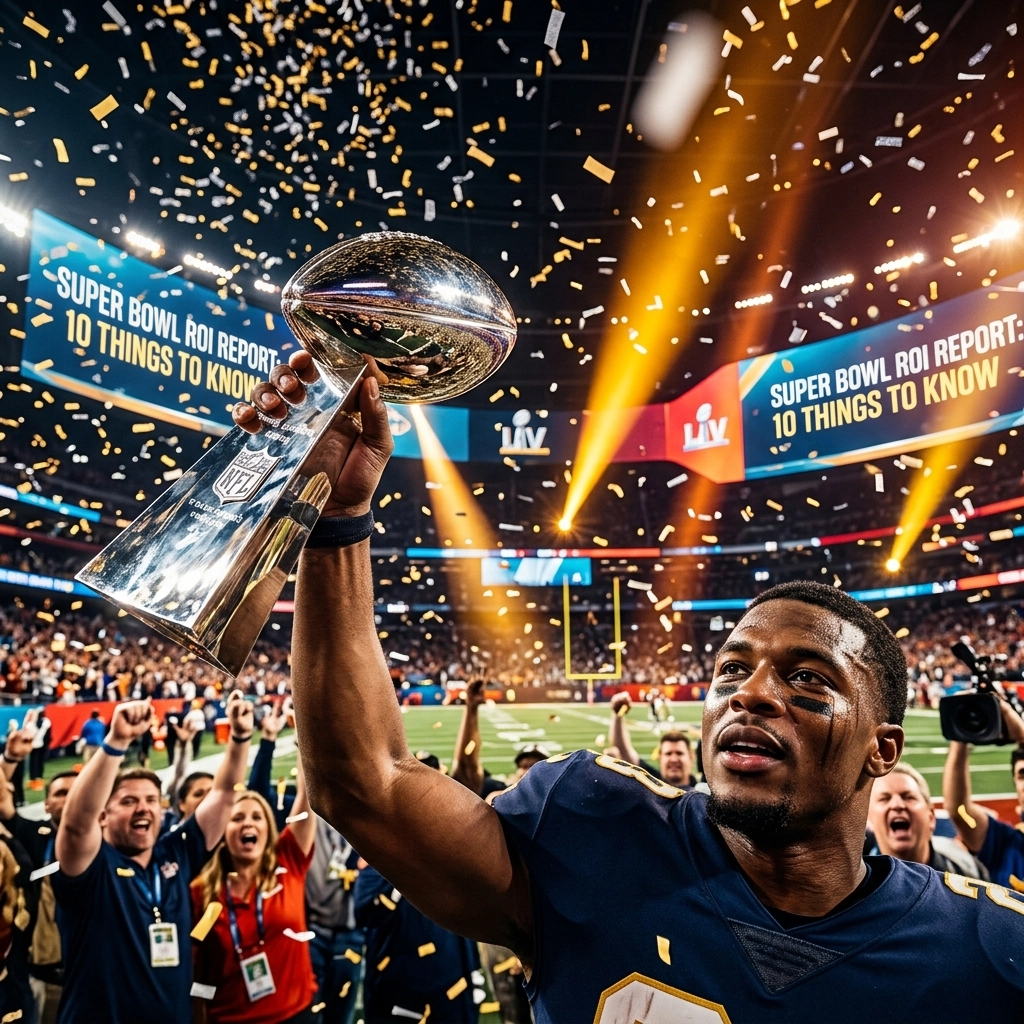
Hey there, Dan Kost here. If you are a CMO or a brand stakeholder, you’ve probably spent the last few months dissecting every penny of your Q1 spend. But now that the dust has settled on the 2026 Super Bowl, the data is finally in. We are seeing some of the most incredible shifts in sports marketing history.
This is part of our Super Bowl Blitz Newsletter (Batch 1/2), where we are spending the next 72 hours giving you the raw, strategic insights you need to win. If you missed the live breakdown, check out our latest video analysis here:
https://www.youtube.com/watch?v=l6J-0zileKE
Let’s get into the meat of the report. Here are the 10 things you absolutely need to know about the Super Bowl ROI Report for 2026.
1. Record-Breaking Peak Reach
This year, we didn’t just break the ceiling. We shattered it. Super Bowl LX reached a peak of 137.8 million viewers. That is the highest in U.S. television history. With an average audience of 124.9 million, we are looking at a level of concentrated attention that simply doesn't exist anywhere else in the world.
For a CMO, this means your cost-per-impression is actually becoming more competitive. Even with the price of ad slots rising, the sheer volume of eyeballs makes it a 25X audience advantage over any other "premium" program.
2. ROI Has Nearly Doubled
This is the headline everyone is talking about. The average ROI for a Super Bowl investment in 2026 has jumped to $5.20 for every dollar spent. Compare that to 2020, where the average was around $2.70.
Why the jump? It is the convergence of digital and linear. We aren't just watching a commercial. We are participating in a multi-screen event. At Name. Image. Likeness., we focus on how digital marketing bridges that gap. If you want to see how athletes are leveraging this same momentum, check out our marketplace at https://mysportsmedia.com/nil.

A photo-realistic image of a modern marketing executive in a high-tech office, looking at a large digital screen displaying upward trending ROI graphs and Super Bowl analytics.
3. The 20x Effectiveness Gap
The report highlights that Super Bowl ads are now roughly 20 times more effective than regular TV advertising. When you run a spot on a random Tuesday night, you are fighting for attention against phones, chores, and "second-screen" distractions.
During the Super Bowl, the ad is the entertainment. This cultural "echo chamber" means the message sticks better, lasts longer, and requires fewer repetitions to drive a consumer to action.
4. The Social Media Multiplier Effect
The 2026 report found that the game generated over $550 million in earned media value (EMV) across social platforms. If your ad didn’t start a conversation on X, Instagram, or TikTok, you left money on the table.
The brands that saw the $5.20 ROI were the ones that created "meme-able" content. They didn’t just buy a 30-second spot. They bought a week-long conversation. Social media is no longer the secondary platform. It is the engine that keeps the ROI climbing long after the trophy is lifted.
5. High Purchase Intent
One of the most surprising stats in the 2026 report is that 43% of viewers said the ads directly increased their interest in purchasing or visiting the brand’s website. In the past, Super Bowl ads were seen as "brand awareness" plays.
Now, they are "conversion" plays. With QR codes and instant-buy integrations, the distance between "seeing an ad" and "making a purchase" has shrunk to about three seconds.
6. Creative Quality is a 12x Multiplier
Not all ads are created equal. The data shows that high-quality, emotionally-driven storytelling delivers a 12x profitability multiplier compared to low-quality or "safe" creative.
If you play it too safe, you are essentially throwing $7 million into a void. The ROI report specifically mentions that "creative effectiveness" delivered 30% greater returns this year. It pays to be bold, and it pays to be human.

7. The Marketing Efficiency Multiplier
This is a "hidden" benefit that many CMOs overlook. A Super Bowl investment actually makes the rest of your marketing cheaper.
When you have the massive brand recognition that comes from a Super Bowl spot, your cost-per-click (CPC) on search ads goes down. Your click-through rates (CTR) on social media go up. People are more likely to open your emails. The report suggests that even a 3% efficiency gain across your annual budget can cover the entire cost of the Super Bowl ad within 12 months.
8. The "Long Tail" of ROI (The 40% Rule)
The ROI doesn't stop when the game ends. In fact, about 40% of the total value generated by a Super Bowl campaign happens in the months following the event.
The brands that won big in 2026 were the ones that had a "Day 2" strategy. They used their NIL (Name, Image, Likeness) partners to keep the momentum going. If you aren't thinking about how to sustain that energy, you are cutting your returns in half.

A realistic photo of a diverse group of young adults in a living room, reacting with excitement while looking at their phones and a large television during a major sporting event.
9. Fan Sentiment and Brand Affinity
The 2026 report put a huge emphasis on "Sentiment Analysis." It is not just about how many people saw your ad, but how they felt about it.
Brands that aligned themselves with positive fan sentiment – whether through humor, inspiration, or supporting a cause – saw a 22% increase in word-of-mouth during the week after the game. In a world where trust is the primary currency, that kind of affinity is priceless.
10. Stock Performance and Long-Term Strategy
Finally, the report looked at the big picture. Companies that invest in consistent, high-impact Super Bowl strategies tend to see better long-term stock performance.
However, there is a catch. If you do a "one-and-done" ad without a sustained marketing plan, you might see a temporary dip. The winners are the ones who view the Super Bowl as a kickoff for a year-long strategy, not a finish line.

A realistic, close-up shot of a professional tablet displaying a detailed marketing dashboard with various KPIs, social media metrics, and a "High Performance" tag.
Wrapping It Up
The 2026 Super Bowl ROI Report proves that the "Big Game" is still the undisputed heavyweight champion of marketing. But it also shows that the game has changed. It is more digital, more social, and more measurable than ever before.
If you are looking to get better returns on your marketing spend, you need to be looking at the intersection of athlete influence and digital reach. That is exactly what we do here.
Stay tuned for Batch 2/2 of our Super Bowl Blitz coming tomorrow. We’ll be diving deeper into the specific creative trends that drove these numbers.
Dan Kost, CEO
Name. Image. likeness.
Digital Marketing Specialists
info@MySportsMedia.com
mysportsmedia.com/nil
(555) 012-3456
#HighPerformance
Share this post:
[Facebook] | [Instagram] | [LinkedIn] | [X]

