

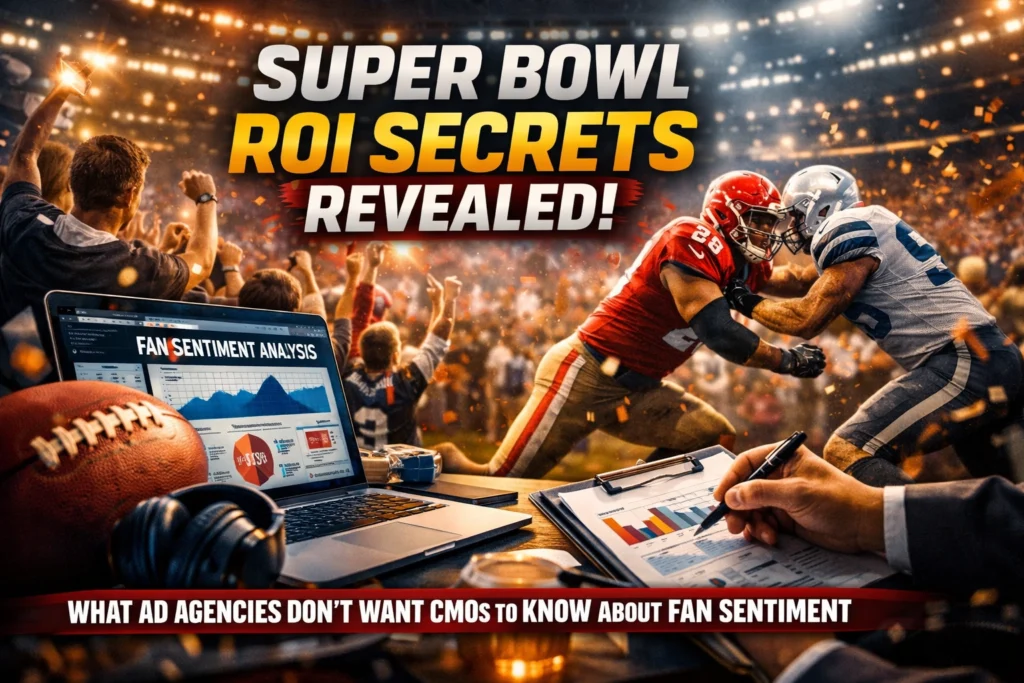
Let’s be honest. The Monday after the Super Bowl is usually a victory lap for ad agencies. They sit in high-rise offices, refreshing the USA Today Ad Meter scores, and popping champagne if their client cracked the top five for "likeability." But if you are a CMO looking at a $7 million invoice for 30 seconds of airtime, you aren’t looking for "likes." You are looking for a return on investment (ROI) that actually moves the needle.
There is a massive disconnect happening in the world of sports marketing. Your agency is selling you sentiment, but the data is telling a much more complicated story. At Name. Image, likeness., we believe in looking behind the curtain. Here is what the big firms don’t want you to know about Super Bowl ROI and why fan sentiment is often a trap.
The Likeability Lie: Why "Winning" the Ad Meter Doesn't Matter
Every year, the industry fixates on which ad was the funniest or most heartwarming. We call this the "Fan Sentiment Trap." Research consistently shows that USA Today’s Ad Meter scores, the industry standard for measuring how much people enjoyed an ad, have almost no correlation with actual financial performance.
Think about that for a second. You could have the most beloved commercial of the year and still see your stock price dip or your sales remain flat. Academic research using Nielsen data found that while a brand like Budweiser once achieved a 172% ROI with a 15.75% spike in sales following the game, they are the exception, not the rule.
In fact, an analysis of Super Bowl advertisers from 2021 to 2024 revealed that these companies underperformed the S&P 500 by 9.2% six months after the game. Only 25% of individual advertisers actually beat the market. If you are a CMO, those are terrifying odds. Your agency is focused on the 30-second "moment," but your board is focused on the next two quarters.

The Viral Traffic Illusion
Agencies love to show you "hockey stick" graphs of website traffic immediately following an ad. And the spikes are real. In 2024, TurboTax saw a staggering 24,875% increase in DNS traffic right after their spot aired. e.l.f. Cosmetics saw an 8,118% jump.
But here is the secret: that traffic is enormous, but it is also ephemeral. A Similarweb analysis tracking 28-day post-game traffic across all Super Bowl advertisers found that the average sustained increase was only about 1%. The "viral" spike vanishes almost as fast as it appears. If you don't have a backend strategy to capture and convert that traffic in real-time, you are essentially paying millions of dollars for a digital flash in the pan.
The Sentiment Trap: Buzz vs. Business
Data from YouGov BrandIndex shows that out of 50-plus advertisers in any given year, only about 10 see a "buzz lift" that is actually statistically significant. For the other 40 brands, the noise of the game is so loud that their message gets lost. Even for the lucky 10 that do see a lift, that positive sentiment usually lasts a maximum of two weeks.
When we talk about #HighPerformance marketing, we aren't talking about two weeks of "good vibes." We are talking about building a brand that resonates with fans through the athletes they actually follow and trust. This is where Name, Image, and Likeness (NIL) changes the game.
Check out this strategic deep dive on how to maximize your reach without falling for the agency hype:
https://www.youtube.com/watch?v=l6J-0zileKE
Beyond the 30-Second Spot: The Integrated Approach
The brands that actually win the Super Bowl: not the Ad Meter, but the ROI battle: treat the television commercial as the centerpiece of a much larger, multi-channel campaign. They don't rely on organic buzz. They manufacture it.
This is where the traditional agency model is failing CMOs. They spend 90% of the budget on production and airtime, leaving only 10% for the actual "connective tissue" of the campaign. To get a real return, you need to leverage the reach of the 127 million viewers by pushing them toward something tangible.
One of the most effective ways to do this is through NIL partnerships. Instead of just having a celebrity appear in a commercial, imagine 50 high-impact college and professional athletes engaging with their specific fanbases simultaneously across social media. That isn't just a "spike," it is a sustained conversation.
Strategic Insights for CMOs
If you want to avoid the pitfalls of the "sentiment trap" in 2026 and beyond, here are three things you should demand from your marketing team:
- Correlation Metrics: Stop looking at "likes" and start looking at how sentiment scores correlate with your customer acquisition cost (CAC). If the agency can't show a link between their "creative genius" and your sales data, it’s just expensive art.
- First-Party Data Capture: If you are going to pay for a traffic spike, you must have a plan to own that data. Use the Super Bowl moment to drive fans to a dedicated NIL marketplace or a loyalty program signup where you can continue the conversation long after the game ends. Explore more at https://mysportsmedia.com/nil.
- The Athlete Advocacy Model: Fans are increasingly cynical about polished, high-budget commercials. They are much more likely to trust a recommendation from an athlete they follow. By integrating NIL programs into your strategy, you create a layer of authenticity that a 30-second script can't replicate.

How Name. Image, likeness. Can Help
At Name. Image, likeness., we don't just focus on the "big game." We focus on the big picture. Our digital marketing strategies are designed to bridge the gap between athlete influence and brand ROI. We help CMOs navigate the complex world of NIL to ensure that every dollar spent on fan engagement is backed by a strategy for conversion.
Whether you are looking to launch a nationwide campaign or a hyper-local athlete partnership, our team understands the nuances of fan sentiment. We know that real ROI comes from building community, not just buying eyeballs.
If you are ready to stop falling for the "likeability" trap and start seeing real financial returns on your sports marketing spend, it’s time to change your approach. You can learn more about our specific programs and how we empower both brands and athletes at https://affilate.mysportsmedia.com/nil-program-details.
FAQs for CMOs
Q: Is a Super Bowl ad still worth the $7 million price tag?
A: It depends on your integration. If it is a standalone spot, the data suggests you will likely underperform the market. If it is the anchor for a massive NIL and digital marketing campaign, the $4.60 to $5.20 return per dollar spent is achievable.
Q: How do we measure the long-term impact of fan sentiment?
A: You have to look past the two-week buzz window. Track brand search intent and conversion rates over a six-month period to see if the sentiment actually translated into brand loyalty.
Q: Can NIL partnerships replace traditional TV advertising?
A: They shouldn't replace it, but they should certainly augment it. NIL provides the authenticity and direct-to-consumer access that traditional media lacks. It’s about building a multi-layered brand presence.
Contact Information
For more strategic insights or to discuss how we can help your brand achieve #HighPerformance results, reach out to our team today.
Dan Kost, CEO
Email: info@MySportsMedia.com
Website: mysportsmedia.com/nil
Phone: Contact via our digital receptionist on the website.
Follow us and share this post:
[Facebook] | [Instagram] | [LinkedIn] | [X]
#HighPerformance
Press Release (Daily Blitz Batch 1/2)
FOR IMMEDIATE RELEASE
Name. Image, likeness. Challenges Industry Norms with New Super Bowl ROI Analysis
DENVER, CO – March 5, 2026 – Name. Image, likeness., a leader in digital marketing and NIL strategies, released a critical analysis today challenging the traditional metrics used by ad agencies to measure Super Bowl success. Led by CEO Dan Kost, the firm argues that the industry's obsession with "fan sentiment" and "likeability" is distracting CMOs from the lack of long-term financial ROI.
The report highlights a growing gap between viral traffic spikes and sustained business growth, noting that many advertisers underperform the S&P 500 in the months following the big game. Name. Image, likeness. advocates for a shift toward integrated athlete-driven campaigns that prioritize first-party data capture and long-term brand advocacy over ephemeral buzz.
"Agencies are selling a 30-second dream, but CMOs are living a 365-day reality," said Dan Kost, CEO. "We are here to provide the strategic tools to ensure that sports marketing spend translates into measurable bottom-line growth."
For more information, visit mysportsmedia.com/nil.
Contact:
Dan Kost, CEO
info@MySportsMedia.com
(Phone via Website)

