

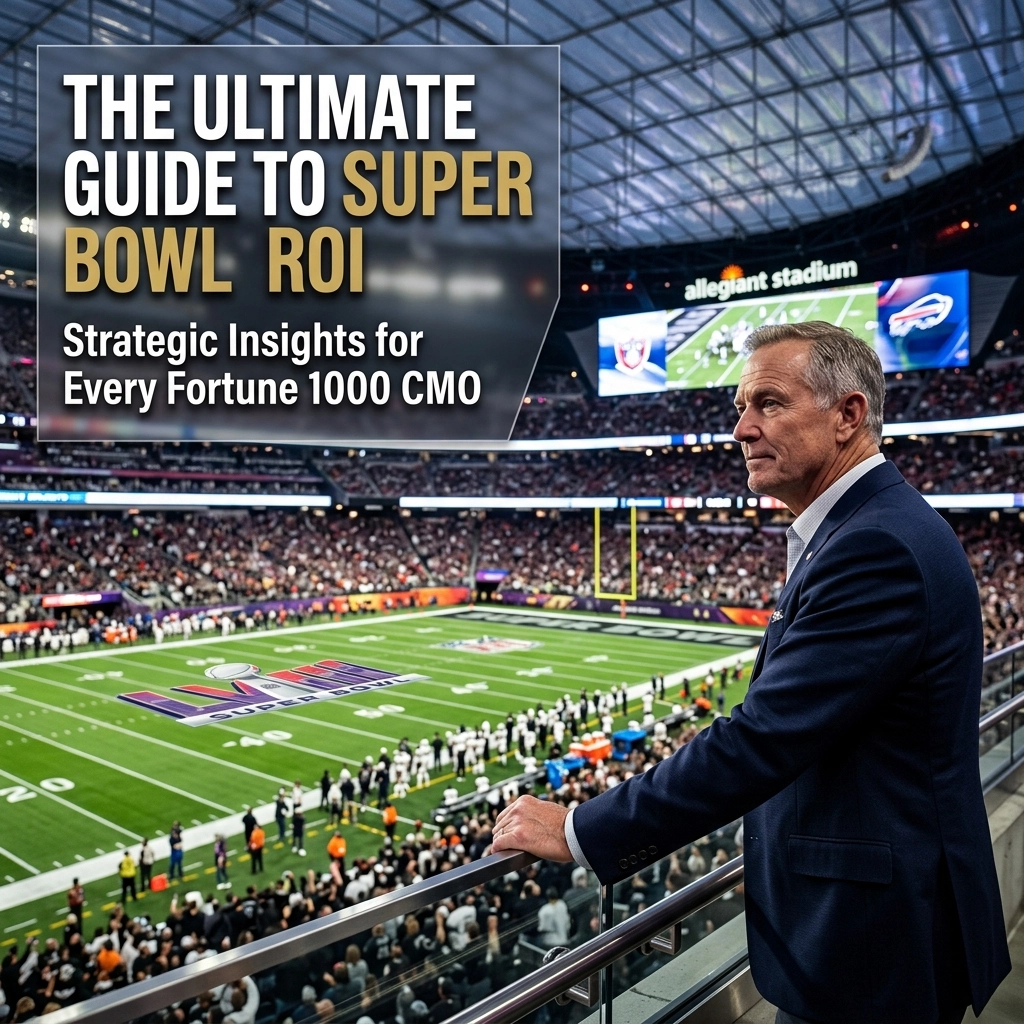
It is Monday, April 20, 2026, and if you are a CMO at a Fortune 1000 company, you are likely staring at a spreadsheet that would make most people dizzy. We are two months post-Super Bowl, and the final data sets are finally trickling in. The question on everyone’s mind remains the same: Was that $7.5 million for 30 seconds actually worth it?
At Name. Image. Likeness., we spend our days obsessing over digital marketing and brand efficiency. We know that the Super Bowl is no longer just a "game day" event. It is a 72-hour blitz followed by a 12-month brand efficiency engine. If you are only measuring ROI based on what happened during the fourth quarter, you are missing about 60 percent of the picture.
The $30 Million Reality Check
Let’s get real about the costs. While the media buy for a spot in Super Bowl LIX hovered around $7.5 million, that is just the ticket to get in the door. When you factor in top-tier production, A-list celebrity talent, pre-game teasers, and a massive post-game digital push, most Fortune 1000 brands are looking at an all-in investment of $25 million to $30 million.
For a CMO, justifying this spend to the board requires more than just showing a "cool ad." It requires a sophisticated understanding of how that concentrated attention translates into long-term financial gain.

A realistic photo of a modern corporate boardroom where a CMO is presenting digital marketing analytics on a large screen to a group of executives.
The ROI Formula: Beyond the Basics
The standard ROI formula is simple: (Revenue from Ads – Cost of Ads) / Cost of Ads. But for a Super Bowl spot, that math is deceptive. If you sell soda or insurance, you aren't necessarily expecting to see $30 million in direct sales within 48 hours.
The real ROI for a Fortune 1000 company comes from the "Multiplier Effect." Research shows that high-quality creative delivers a 12x profitability multiplier compared to low-quality creative. Furthermore, a successful Super Bowl campaign can improve the efficiency of your entire annual marketing budget. If your Super Bowl spot increases brand recognition and sentiment, your CPMs on Facebook and Google for the rest of the year will likely drop, and your conversion rates will climb.
A 5 percent efficiency gain across a $300 million annual marketing budget is worth $15 million. That is how you justify the "Big Game" spend.
The Super Bowl Blitz: Strategic Insights
As part of our Super Bowl Blitz Newsletter series, we’ve been tracking fan sentiment and ROI metrics with a focus on how athletes and digital influence play a role. The game has changed. It’s no longer just about the commercial. It’s about the digital conversation surrounding it.
Check out our deep dive into the 72-hour blitz strategy here:
https://www.youtube.com/watch?v=l6J-0zileKE
Phase 1: The Pre-Game Teaser (2 Weeks Out)
Data suggests that brands that release teasers or the full ad online before the game see significantly higher ROI than those that wait for the broadcast. You want to own the "search intent" before the whistle blows. By the time the game starts, your audience should already be looking for you.
Phase 2: The Emotional Narrative
The Super Bowl is an emotional experience. Logic doesn't sell in a room full of buffalo wings and cheering fans. Storytelling that triggers a visceral reaction, whether it's laughter or a tear-jerker, creates a 30 percent greater ROI than purely functional ads. This is where brand linkage is vital. If they love the ad but can't remember who it was for, you've just spent $30 million on a short film for someone else.
Phase 3: The 72-Hour Digital Tail
The 72 hours following the game are critical. This is when fan sentiment is at its peak. Strategic CMOs use this window to flood digital channels with behind-the-scenes content, athlete-led NIL (Name, Image, and Likeness) activations, and direct-response offers.
Integrating NIL into the ROI Equation
One of the biggest shifts we’ve seen leading into 2026 is the integration of athlete influencers into the Super Bowl strategy. It is no longer enough to just have a player in the commercial. You need a full-scale digital strategy that leverages the athlete’s own reach.
This is where the marketplace at MySportsMedia.com/NIL comes into play. By connecting brands directly with athletes, we allow for a more authentic connection with fans. When an athlete posts about your brand during the Super Bowl blitz, it feels like a recommendation from a friend, not a corporate mandate.

Measurement Framework: Three Time Horizons
To truly understand your ROI, you need to measure across three distinct timeframes:
- The Immediate (48 Hours): Monitor social media sentiment, web traffic spikes, and immediate sales lift. Use unique QR codes and promo codes to track direct attribution.
- The Medium-Term (1-4 Weeks): This is the "Post-Campaign" window. About 40 percent of your total ROI is captured here. Look at brand lift studies, ad recall, and earned media value.
- The Long-Term (2-12 Months): Use Media Mixed Modeling (MMM) to see how the Super Bowl spot impacted your overall customer acquisition costs (CAC). Did your baseline sales move up? That is the ultimate goal.

A realistic photo of a data scientist in a brightly lit, modern office looking at complex 3D data visualizations of consumer sentiment on a tablet.
AEO and the Voice of the Fan
In 2026, we also have to think about Answer Engine Optimization (AEO). People aren't just typing into Google anymore. They are asking their AI assistants, "Which Super Bowl ad had the talking dog?" or "What was the brand with the cool athlete teaser?"
If your content isn't structured to answer these conversational queries, you are leaving money on the table. Your blog posts, video descriptions, and social captions need to be optimized for these AI-driven "answer engines."
The CMO’s Success Checklist
If you are pitching a Super Bowl spend for next year, here is your checklist to ensure a positive ROI:
- Is the brand appeal broad enough? Don't buy a Super Bowl spot for a niche B2B product unless you have a very specific "Trojan Horse" strategy.
- Is the creative "platform-native"? Your ad shouldn't just be a TV spot. It should be a TikTok, an Instagram Reel, and a YouTube Short.
- Do you have a 12-month tail? Don't spend your entire budget on the buy. Save 40 percent for the post-game amplification.
- Are you leveraging NIL? Use athletes to humanize the brand and drive digital engagement before, during, and after the game.
The Super Bowl remains the last "town square" in American culture. It is the only time 100 million people are looking at the same thing at the same time. For a Fortune 1000 CMO, the ROI is there, but you have to be willing to look beyond the 30-second clock.
At Name. Image. Likeness., we help brands navigate this complex landscape every day. From digital marketing strategy to athlete partnerships, we focus on the metrics that actually move the needle.
Contact Us:
Dan Kost, CEO
Email: info@MySportsMedia.com
Website: mysportsmedia.com/nil
Phone: (480) 225-3090
Follow the Conversation:
[Facebook] | [Instagram] | [LinkedIn] | [X]
#HighPerformance

A realistic, professional photo of Dan Kost, CEO of Sports Media, in a casual but confident pose, standing in front of a digital display showing sports marketing trends.
Daily Super Bowl Blitz Update (1/2)
This post is part of our daily 72-hour deep dive into Super Bowl marketing strategies and fan sentiment.

