

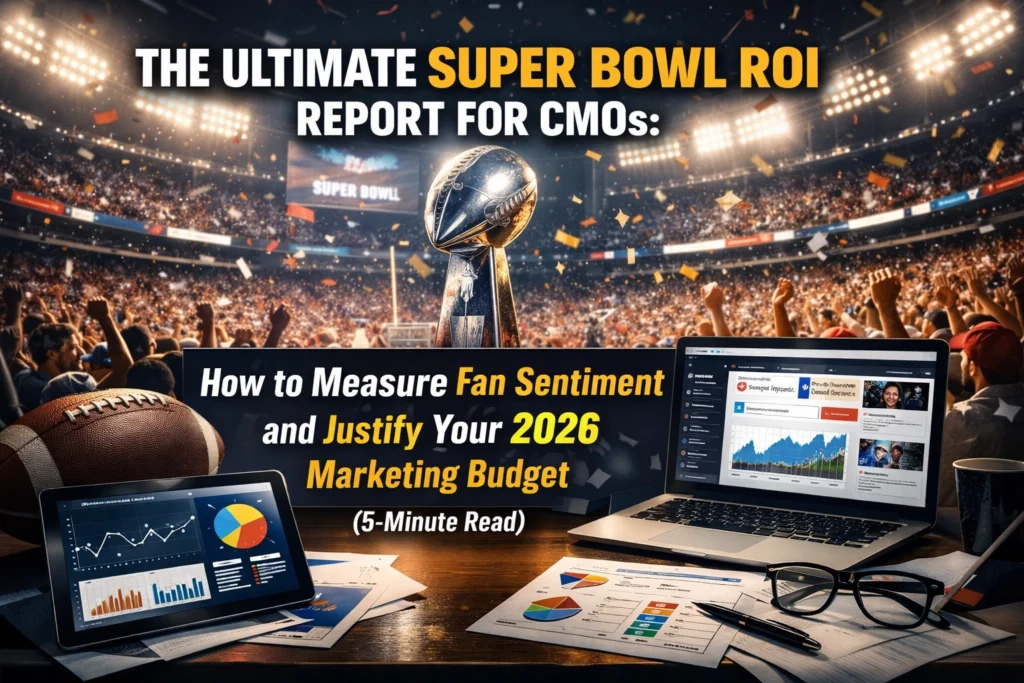
Let's get real for a second. You just dropped $8 million on a 30-second Super Bowl spot. Your CFO is side-eyeing your budget proposal. Your board wants numbers. Hard numbers. Not "brand awareness vibes" or "cultural moment magic." They want to know if that Super Bowl investment actually moved the needle, or if you just paid for the world's most expensive vanity project.
Here's the good news: The ROI conversation has completely changed. Super Bowl advertising now delivers $5.20 in return for every dollar invested when you measure the full campaign cycle. That's nearly double what brands were seeing back in 2020. But here's the catch, you need to know what to measure, when to measure it, and how to connect the dots between fan sentiment and actual business outcomes.
And if you're thinking about integrating athlete partnerships or NIL marketing into your Super Bowl strategy? You're already ahead of the curve. Check out this game-changing approach to modern sports marketing that's redefining how brands connect with athletes and fans:
Watch: The Future of Sports Marketing & NIL
The New Super Bowl Math: Why the ROI Actually Works Now
Remember when Super Bowl ads were just expensive gambles? Those days are over. The data tells a completely different story now.

Super Bowl ads are now approximately 20 times more effective than regular television advertising on a per-dollar basis. That's not a typo. 20X. Why? Because you're not just buying 30 seconds during a football game. You're buying into a cultural phenomenon that generates conversations for weeks before and after the event.
The 2026 Super Bowl generated $550 million in earned media value for brands on social media alone. We're talking about 764 billion potential impressions with a 0.19% engagement rate, which might sound small until you realize that's considered incredibly strong for mass-audience content.
Here's what your CFO needs to understand: that $8 million media buy is the entry ticket. The real value comes from the amplification, the social conversation, the earned media, and the extended campaign ecosystem you build around that single moment. When you measure the full cycle, the math actually works.
The Metrics That Actually Matter (And The Ones Your Board Cares About)
Let's break down the KPIs that separate successful Super Bowl campaigns from expensive mistakes:
Return on Ad Spend (ROAS): Track direct attribution through promotional codes, QR codes, and landing page traffic. In 2026, 43% of viewers reported that Super Bowl ads increased their interest in learning more about a brand or visiting its website. That's actionable intent, not passive awareness.
Earned Media Value (EMV): This is where the magic happens. Social mentions, PR coverage, influencer amplification, and yes, athlete partnerships through NIL deals can extend your reach exponentially. Pepsi led brand mentions in 2026 with 38,188 mentions. Apple Music and Budweiser followed close behind. Each mention is essentially free advertising that compounds your initial investment.
Audience Scale Advantage: The Super Bowl delivered 124.9 million viewers with a peak of 137.8 million. That's a 25X audience advantage over typical television programming. In an era where most shows attract only 5 million viewers, you're paying a premium, but you're actually getting premium reach.
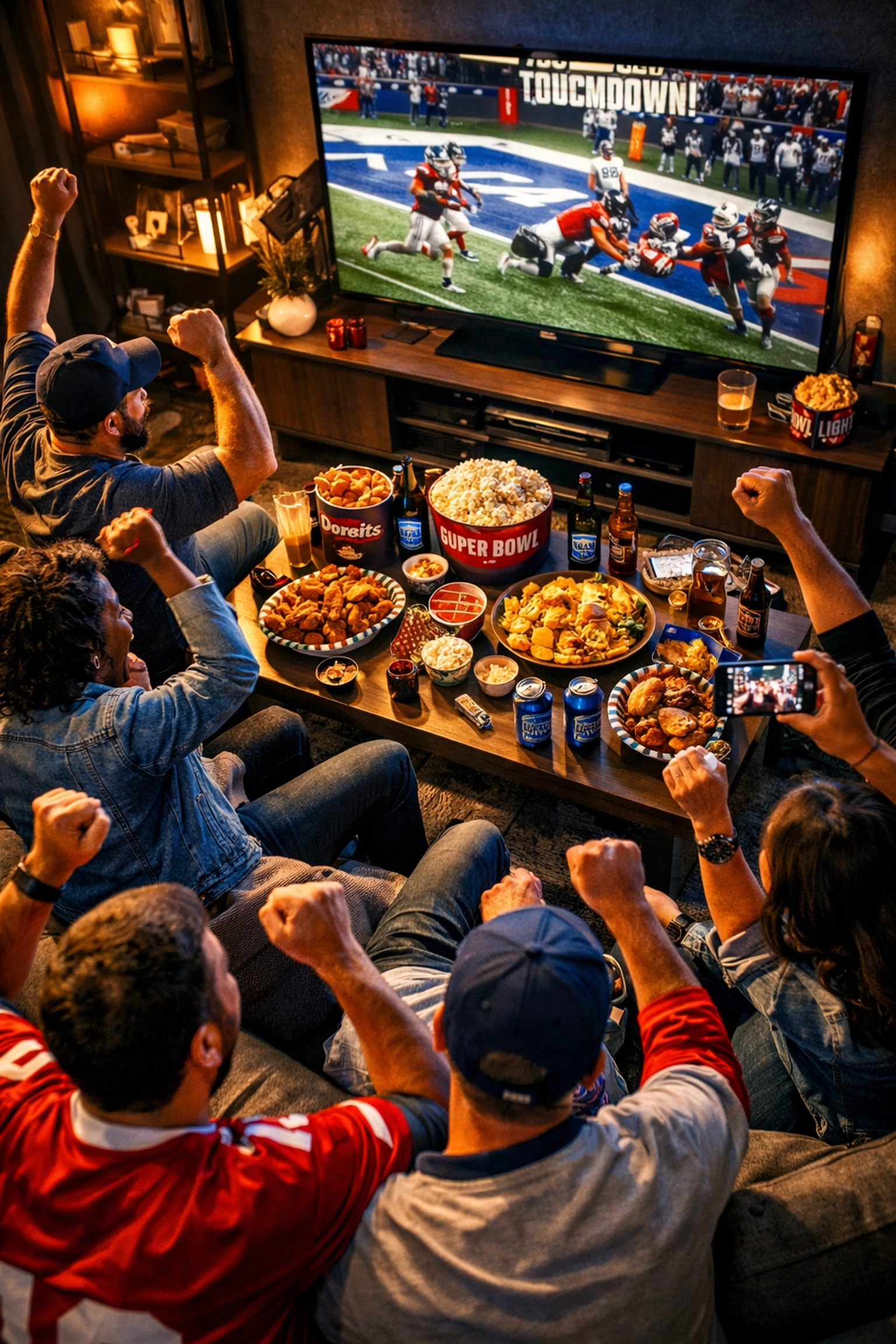
The Brand Recall Challenge: Here's the uncomfortable truth. Almost 3X more viewers recalled the entertainment value (the joke, the celebrity, the story) than the actual brand itself. This means your creative has to work as entertainment first to achieve advertising effectiveness second. If viewers remember the funny dog but can't name your company, you've wasted $8 million on someone else's viral moment.
Measuring Fan Sentiment: Beyond Likes and Shares
Social chatter peaked at 9:30 p.m. ET during the 2026 Super Bowl when game outcomes became decisive, generating over 28 million engagements. But raw engagement numbers don't tell you if people actually liked your ad or if they're roasting it.
Here's what smart CMOs are tracking now:
Sentiment Analysis Across Platforms: Use AI-powered tools to categorize mentions as positive, negative, or neutral. Track sentiment shifts in real-time during the game and for 72 hours afterward. The conversation doesn't stop when the final whistle blows.
The Polarization Advantage: Counter-intuitively, 2026 data revealed that polarizing ads outperformed universally likable ones on social platforms. The top-performing ad achieved a composite social impact score more than 3X higher than the second-place finisher, despite generating divided opinions. This suggests you should prioritize authentic emotional reactions over trying to please everyone. Controversial doesn't mean bad. It means memorable.
Athlete and Influencer Amplification: This is where NIL marketing becomes your secret weapon. When athletes with authentic followings share and engage with your content, you're not just reaching their audience. You're earning credibility with communities that ignore traditional advertising. Track athlete-driven engagement separately, it often converts at higher rates than brand-direct messaging.
Want to explore how athlete partnerships can amplify your campaigns? Learn more about strategic NIL programs here: https://mysportsmedia.com/nil
Building Your 2026 Budget Justification: The Numbers Your CFO Needs
Here's your CFO's biggest concern: "Why should we spend $8 million on 30 seconds when we could fund an entire quarter of digital campaigns?"
Here's your answer:
Cost Stability Creates Planning Certainty: 2026 marked the first year without a price increase for Super Bowl ads. Costs remained flat at $8 million from 2025 to 2026. After growing from $5.4 million in 2016, this pricing plateau gives CMOs predictability. Analysts project pricing will stabilize in the $8-10 million range through 2030 rather than continuing previous growth trajectories. Translation: Buy now before the next wave of inflation hits.

Multi-Platform Amplification ROI: The $8 million media buy is only your starting point. Brands that extend campaigns across social media, digital channels, and traditional advertising for weeks before and after the game maximize impact beyond the initial broadcast investment. Budget for this amplification as part of your total campaign cost. Think of the Super Bowl spot as the ignition, not the entire engine.
Production and Activation Costs: Your all-in cost typically includes media buy ($8-10 million for 30 seconds), production (another $2-5 million for top-tier creative), and ongoing amplification costs. This is the complete cycle that generates the documented $5.20 return per dollar. Don't cheap out on production. With 66 ads airing in 2026, the bottom third of advertisers received virtually no measurable social impact despite spending identical amounts on media placement.
Creative Excellence Determines ROI: Media placement doesn't guarantee results. Creative execution does. Allocate budget toward award-winning creative partners and authentic emotional storytelling. The difference between a viral success and an expensive flop often comes down to creative quality, not media spend.
The NIL Advantage: Why Athlete Partnerships Amplify Super Bowl Campaigns
Here's what most CMOs miss: your Super Bowl ad doesn't exist in isolation. The brands winning biggest in 2026 integrated athlete partnerships and NIL deals into their pre-game, in-game, and post-game strategies.
Athletes bring authentic audiences that trust their recommendations. They extend your campaign reach organically. And when an athlete with 2 million engaged followers shares your Super Bowl spot with genuine enthusiasm, you've just earned media value that would cost hundreds of thousands to buy directly.
The future of sports marketing isn't just about buying ads during games. It's about building relationships with the athletes playing in them. Name. Image, likeness. helps brands navigate this landscape strategically, connecting CMOs with athlete partnerships that deliver measurable ROI beyond the big game.
Explore partnership opportunities: https://affilate.mysportsmedia.com/nil-program-details
Your Action Plan: Turning Insights Into Budget Approval
Here's your playbook for justifying your 2026 Super Bowl investment:
Document Everything: Track ROAS, EMV, sentiment scores, athlete amplification metrics, and brand recall data. Build your case with numbers, not intuition.
Plan the Full Campaign Cycle: Budget for pre-game teasing, the main event, post-game amplification, and athlete partnerships that extend your reach.
Invest in Creative Excellence: The difference between $5.20 ROI and breaking even is creative quality. Don't skimp here.
Leverage Athlete Partnerships: NIL deals aren't just for shoe companies anymore. Smart CMOs are integrating athlete voices into every major campaign.
Measure Beyond the Game: Your campaign doesn't end when the confetti falls. Track performance for at least 30 days post-game to capture the full impact.
The Super Bowl remains advertising's biggest stage. The difference between success and expensive failure comes down to measurement, strategy, and execution. Know your metrics. Build your amplification plan. And don't be afraid to embrace athlete partnerships that extend your message authentically.
The ROI is real. The data proves it. Now go make your case.
Ready to amplify your marketing strategy with athlete partnerships?
Contact Dan Kost, CEO
Email: info@MySportsMedia.com
Website: mysportsmedia.com/nil
Share this post:
Facebook | Instagram | LinkedIn | X
#HighPerformance #SuperBowlMarketing #NIL #CMOInsights #SportsBusiness #AthleteMarketing #ROI #MarketingStrategy

