Let's be honest for a second. Every year, we watch the Super Bowl, we see the million-dollar ads, and we check the "USA Today Ad Meter" the next morning to see who "won." But as a CMO or a brand stakeholder, does a ranking on a popular website actually tell you if your investment worked?
The short answer is no.
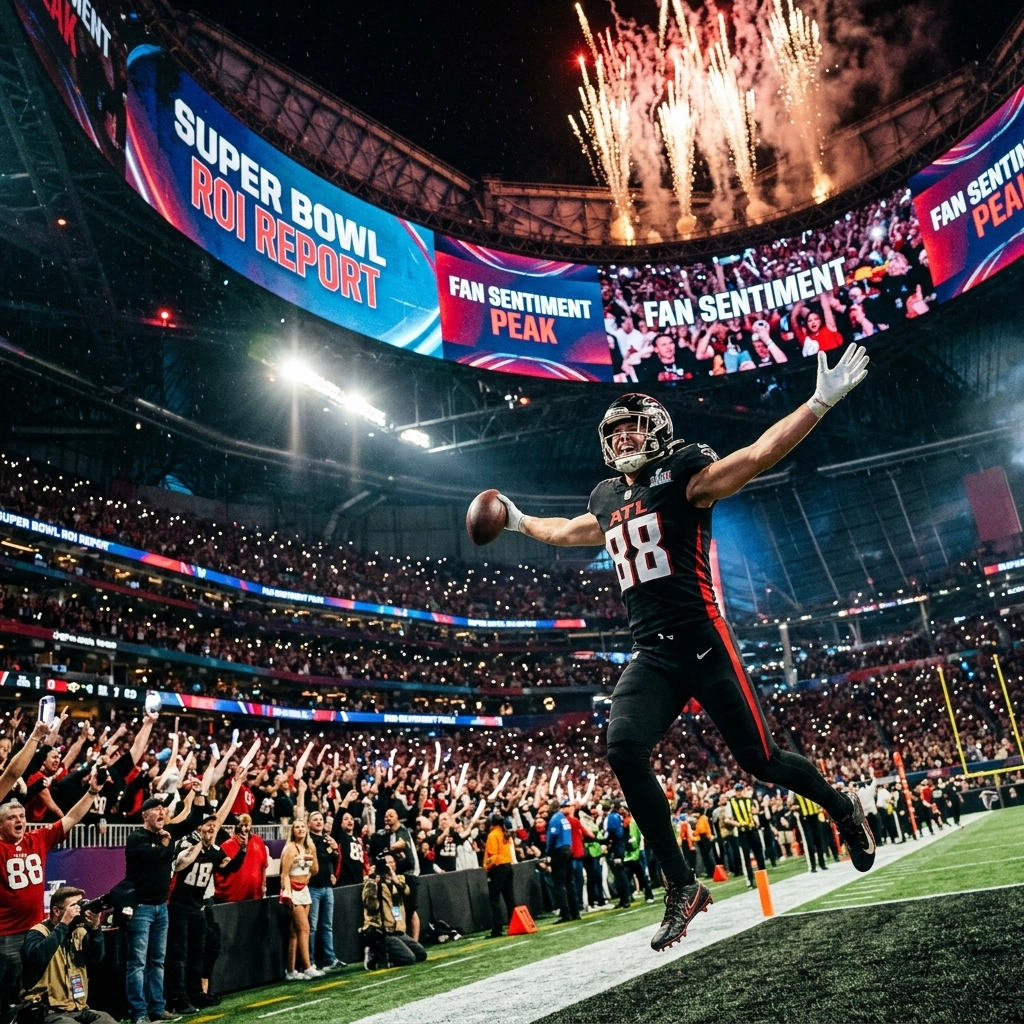
The long answer is found in our latest Super Bowl ROI Report. We spent 72 hours deep-diving into the "Super Bowl Blitz" data, and what we found is going to change the way you look at fan sentiment forever. We aren't just looking at who liked a commercial. We are looking at who actually took action, who shared it, and who stayed engaged long after the final whistle blew.
The 72-Hour Window: Why Game Day Isn't Enough
For decades, marketers have obsessed over the four-hour window of the game. But the reality is that the Super Bowl is a three-day event in the digital world. Our report tracked sentiment and ROI over a 72-hour period. Why? Because the "second wave" of reach is where the real money is made.
When a brand drops a teaser, airs the ad, and then sees creators remixing that content on social media, that is a multi-layered reaction. If you only track the sentiment during the game, you are missing the compounding reach that happens through replays and reactions.

Traditional sentiment analysis is often too shallow. It tells you if people felt "good" or "bad." But our research shows that sentiment is merely a leading indicator. It predicts things like brand trust and conversion intent, but it doesn't guarantee them. To get the full picture, you have to track the behavior across multiple touchpoints.
The Brutal Reality: Traditional ROI hit a Historic Low
Here is a statistic that should keep every marketing executive up at night: traditional advertising ROI hit a historic low of just 1 percent engagement during this cycle.
Think about that. You spend millions on a slot, millions more on production, and only 1 percent of the audience is truly engaging with the brand in a meaningful way. So, where did the attention go?
It went to the stories.
Our report found that narratives centered on "Teamwork and Leadership" generated nearly triple the positive sentiment of the halftime show. Specifically, these narratives pulled in over 156,000 positive mentions, while the halftime show sat at around 56,000. People are hungry for human connection and values. They want to see the "Name. Image. likeness." of the people they admire actually standing for something.
Confusion Kills ROI Faster Than Controversy
One of the biggest takeaways from our analysis is that brands are often too afraid of controversy and not afraid enough of confusion.
In the high-stakes world of Super Bowl advertising, if a fan has to ask "What was that for?" or "What brand was that?", you’ve already lost. Confusion is the silent killer of ROI. Fans will actually forgive a bold, controversial choice if the message is clear. But they rarely forgive being confused.
If you can't answer "What should a fan do next?" in one simple sentence, you aren't ready to spend the money. This is where many brands fell short. They had the "sentiment" (people thought the ad was "cool"), but they had zero "intent" because the call to action was buried under layers of high-concept art.
Sharing Intent vs. Vanity Metrics
We need to stop talking about "likes" and start talking about sharing intent.
The report shows that the most valuable signal you can track is whether a fan says something like "I sent this to…" or "You have to see this." When a fan moves from "I liked it" to "I shared it," they are doing your marketing for you. This "sharing intent" is a much stronger predictor of ROI than simple positive sentiment.

Check out our breakdown of these strategic insights in the video below:
https://www.youtube.com/watch?v=l6J-0zileKE
Why Values-Based Messaging is Changing
We also saw a major shift in how fans respond to values-based messaging. Generic "purpose" statements don't work anymore. Fans are skeptical. They have "BS detectors" that are tuned to a very high frequency.
The winning brands were those that were specific. They didn't just say they cared about a cause. They showed the receipts. They matched their brand behavior with their messaging. This is why athlete-driven content is so powerful right now. When an athlete with a genuine story talks about leadership, it resonates in a way that a corporate script never will.
You can learn more about how we bridge this gap at mysportsmedia.com/nil.
Frequently Asked Questions (AEO)
How long should I track sentiment after a major event like the Super Bowl?
Our report suggests a minimum of 72 hours. This captures the initial reaction, the social media remixing phase, and the "water cooler" talk that happens the following business day.
What is the most important metric for Super Bowl ROI?
While sentiment is important, "Sharing Intent" and "Follow-up Engagement" are the true drivers of ROI. You want to see fans actively passing the content to their own networks.
Why did traditional engagement hit a record low?
Audience fragmentation and "ad blindness" are at all-time highs. Fans are looking for authentic stories and leadership narratives rather than traditional, high-gloss commercials.
How does Name, Image, and Likeness (NIL) impact brand sentiment?
NIL allows brands to tap into the existing trust and community of an athlete. When an athlete’s personal values align with a brand, the sentiment is viewed as more authentic and less "corporate."
The Path Forward for CMOs
If you are still tracking ROI based on a spreadsheet of mentions and a thumbs-up emoji, it is time to upgrade your strategy. The Super Bowl ROI Report proves that the game has changed.
You need to connect sentiment to business metrics like search lift, site behavior, and conversion intent. You need to focus on clarity over "coolness." And most importantly, you need to have a follow-up plan. Positive sentiment that leads to nowhere is just a vanity project.
At Name. Image. likeness., we help brands navigate this new landscape. We don't just look at the numbers. We look at the humans behind the numbers.

Contact Information:
Dan Kost, CEO
Email: info@MySportsMedia.com
Website: mysportsmedia.com/nil
Phone: Contact our reception team for direct inquiries.
Follow Us & Share:
Find us on Facebook, Instagram, LinkedIn, and X.
#HighPerformance
This blog post was created to provide strategic insights for CMOs and brand stakeholders regarding the shifting landscape of fan sentiment and ROI tracking.